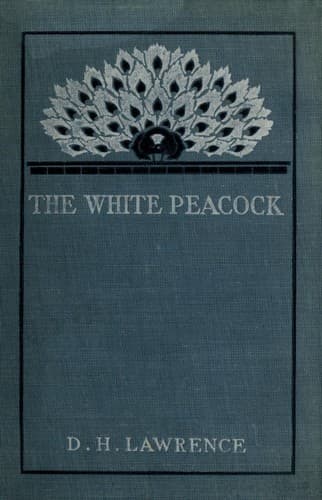
Bildungsromans; Midlands (England) -- Fiction; Young men -- Fiction
“Nay,” said her father gently, “Mollie shall learn the dairying, and
David will just be right to take to the place when I give up. It’ll
perhaps be a bit rough and hard at first, but when we’ve got over it we
shall think it was one of the best times—like you do.”
“And you, George?” asked Lettie.
“I’m not going. What should I go for? There’s nothing at the end of it
only a long life. It’s like a day here in June—a long work day,
pleasant enough, and when it’s done you sleep well—but it’s work and
sleep and comfort,—half a life. It’s not enough. What’s the odds?—I
might as well be Flower, the mare.”
His father looked at him gravely and thoughtfully.
“Now it seems to me so different,” he said sadly, “it seems to me you
can live your own life, and be independent, and think as you like
without being choked with harassments. I feel as if I could keep
on—like that——”
“I’m going to get more out of my life, I hope,” laughed George. “No. Do
you know?” and here he turned straight to Lettie. “Do you know, I’m
going to get pretty rich, so that I can do what I want for a bit. I
want to see what it’s like, to taste all sides—to taste the towns. I
want to know what I’ve got in me. I’ll get rich—or at least I’ll have a
good try.”
“And pray how will you manage it?” asked Emily.
“I’ll begin by marrying—and then you’ll see.”
Emily laughed with scorn—“Let us see you begin.”
“Ah, you’re not wise!” said the father sadly—then, laughing, he said to
Lettie in coaxing, confidential tones, “but he’ll come out there to me
in a year or two—you see if he doesn’t.”
“I wish I could come now,” said I.
“If you would,” said George, “I’d go with you. But not by myself, to
become a fat stupid fool, like my own cattle.”
While he was speaking Gyp burst into a rage of barking. The father got
up to see what it was, and George followed. Trip, the great
bull-terrier, rushed out of the house shaking the buildings with his
roars. We saw the white dog flash down the yard, we heard a rattle from
the hen-house ladder, and in a moment a scream from the orchard side.
We rushed forward, and there on the sharp bank-side lay a little
figure, face down, and Trip standing over it, looking rather puzzled.
I picked up the child—it was Sam. He struggled as soon as he felt my
hands, but I bore him off to the house. He wriggled like a wild hare,
and kicked, but at last he was still. I set him on the hearthrug to
examine him. He was a quaint little figure, dressed in a man’s trousers
that had been botched small for him, and a coat hanging in rags.
“Did he get hold of you?” asked the father. “Where was it he got hold
of you?”
But the child stood unanswering, his little pale lips pinched together,
his eyes staring out at nothing. Emily went on her knees before him,
and put her face close to his, saying, with a voice that made one
shrink from its unbridled emotion of caress:
“Did he hurt you, eh?—tell us where he hurt you.” She would have put
her arms around him, but he shrank away.
Public-domain text, read in full here on John Shaqi.
Reviews
Reviews
No reviews yet
Be the first to share your thoughts on this work.
Elsewhere in the archive
Join the Discussion
Join the discussion
Sign in to leave a comment or review.
Sign InorCreate an account