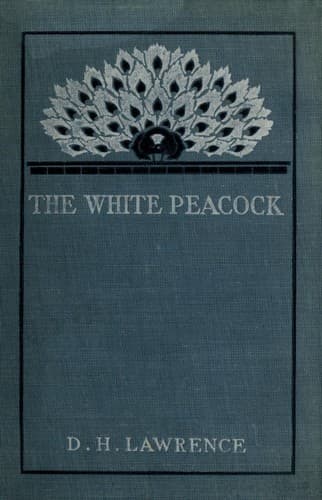
Bildungsromans; Midlands (England) -- Fiction; Young men -- Fiction
Leslie was very ill for some time. He had a slight brain fever, and was
delirious, insisting that Lettie was leaving him. She stayed most of
her days at Highclose.
One day in June he lay resting on a deck chair in the shade of the
cedar, and she was sitting by him. It was a yellow, sultry day, when
all the atmosphere seemed inert, and all things were languid.
“Don’t you think, dear,” she said, “it would be better for us not to
marry?”
He lifted his head nervously from the cushions; his face was emblazoned
with a livid red bar on a field of white, and he looked worn, wistful.
“Do you mean not yet?” he asked.
“Yes—and, perhaps,—perhaps never.”
“Ha,” he laughed, sinking down again. “I must be getting like myself
again, if you begin to tease me.”
“But,” she said, struggling valiantly, “I’m not sure I ought to marry
you.”
He laughed again, though a little apprehensively.
“Are you afraid I shall always be weak in my noddle?” he asked. “But
you wait a month.”
“No, that doesn’t bother me——”
“Oh, doesn’t it!”
“Silly boy—no, it’s myself.”
“I’m sure I’ve made no complaint about you.”
“Not likely—but I wish you’d let me go.”
“I’m a strong man to hold you, aren’t I? Look at my muscular paw!”—he
held out his hands, frail and white with sickness.
“You know you hold me—and I want you to let me go. I don’t want to——”
“To what?”
“To get married at all—let me be, let me go.”
“What for?”
“Oh—for my sake.”
“You mean you don’t love me?”
“Love—love—I don’t know anything about it. But I can’t—we can’t
be—don’t you see—oh, what do they say,—flesh of one flesh.”
“Why?” he whispered, like a child that is told some tale of mystery.
She looked at him, as he lay propped upon his elbow, turning towards
hers his white face of fear and perplexity, like a child that cannot
understand, and is afraid, and wants to cry. Then slowly tears gathered
full in her eyes, and she wept from pity and despair.
This excited him terribly. He got up from his chair, and the cushions
fell on to the grass:
“What’s the matter, what’s the matter!—Oh, Lettie,—is it me?—don’t you
want me now?—is that it?—tell me, tell me now, tell me,”—he grasped her
wrists, and tried to pull her hands from her face. The tears were
running down his cheeks. She felt him trembling, and the sound of his
voice alarmed her from herself. She hastily smeared the tears from her
eyes, got up, and put her arms round him. He hid his head on her
shoulder and sobbed, while she bent over him, and so they cried out
their cries, till they were ashamed, looking round to see if anyone
were near. Then she hurried about, picking up the cushions, making him
lie down, and arranging him comfortably, so that she might be busy. He
was querulous, like a sick, indulged child. He would have her arm under
his shoulders, and her face near his.
“Well,” he said, smiling faintly again after a time. “You are naughty
to give us such rough times—is it for the pleasure of making up, bad
little Schnucke—aren’t you?”
Public-domain text, read in full here on John Shaqi.
Reviews
Reviews
No reviews yet
Be the first to share your thoughts on this work.
Elsewhere in the archive
Join the Discussion
Join the discussion
Sign in to leave a comment or review.
Sign InorCreate an account