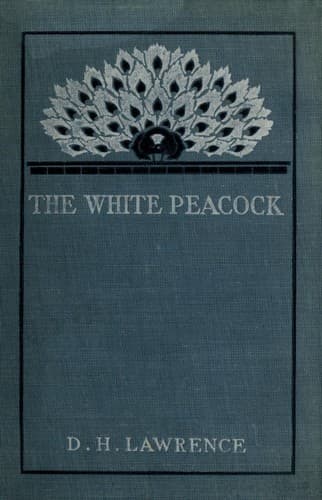
Bildungsromans; Midlands (England) -- Fiction; Young men -- Fiction
Maud Mayhew kept apart from these meetings, watching over her two
children. She had been very unhappily married, and now was reserved,
silent. The women of Eberwich watched her as she went swiftly along the
street in the morning with her basket, and they gloried a little in her
overthrow, because she was too proud to accept consolation, yet they
were sorry in their hearts for her, and she was never touched with
calumny. George saw her frequently, but she treated him coldly as she
treated the other men, so he was afraid of her.
He had more facilities now for his horse-dealing. When the grandmother
died, in the October two years after the marriage of George she left
him seven hundred pounds. To Meg she left the Inn, and the two houses
she had built in Newerton, together with brewery shares to the value of
nearly a thousand pounds. George and Meg felt themselves to be people
of property. The result, however, was only a little further coldness
between them. He was very careful that she had all that was hers. She
said to him once when they were quarrelling, that he needn’t go feeding
the Mayhews on the money that came out of her business. Thenceforward
he kept strict accounts of all his affairs, and she must audit them,
receiving her exact dues. This was a mortification to her woman’s
capricious soul of generosity and cruelty.
The Christmas after the grandmother’s death another son was born to
them. For the time George and Meg became very good friends again.
When in the following March I heard he was coming down to London with
Tom Mayhew on business, I wrote and asked him to stay with me. Meg
replied, saying she was so glad I had asked him: she did not want him
going off with that fellow again; he had been such a lot better lately,
and she was sure it was only those men at Mayhew’s made him what he
was.
He consented to stay with me. I wrote and told him Lettie and Leslie
were in London, and that we should dine with them one evening. I met
him at King’s Cross and we all three drove west. Mayhew was a
remarkably handsome, well-built man; he and George made a notable
couple. They were both in breeches and gaiters, but George still looked
like a yeoman, while Mayhew had all the braggadocio of the stable. We
made an impossible trio. Mayhew laughed and jested broadly for a short
time, then he grew restless and fidgety. He felt restrained and awkward
in my presence. Later, he told George I was a damned parson. On the
other hand, I was content to look at his rather vulgar beauty—his teeth
were blackened with smoking—and to listen to his ineffectual talk, but
I could find absolutely no response. George was go-between. To me he
was cautious and rather deferential, to Mayhew he was careless, and his
attitude was tinged with contempt.
Public-domain text, read in full here on John Shaqi.
Reviews
Reviews
No reviews yet
Be the first to share your thoughts on this work.
Elsewhere in the archive
Join the Discussion
Join the discussion
Sign in to leave a comment or review.
Sign InorCreate an account