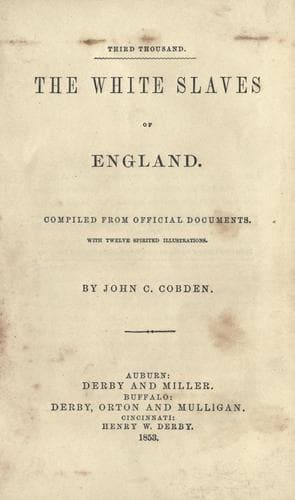
"The evidence in the case of Esther Hibner proved that a number
of girls, pauper apprentices, were employed in a workshop; that
their victuals consisted of garbage, commonly called hog's-wash,
and that of this they never had enough to stay the pains of
hunger; that they were kept half-naked, half-clothed in dirty
rags; that they slept in a heap on the floor, amid filth and
stench; that they suffered dreadfully from cold; that they were
forced to work so many hours together that they used to fall
asleep while at work; that for falling asleep, for not working
as hard as their mistress wished, they were beaten with sticks,
with fists, dragged by the hair, dashed on to the ground,
trampled upon, and otherwise tortured; that they were found, all
of them more or less, covered with chilblains, scurvy, bruises,
and wounds; that one of them died of ill-treatment; and—mark
this—that the discovery of that murder was made in consequence
of the number of coffins which had issued from Esther Hibner's
premises, and raised the curiosity of her neighbours. For this
murder Mrs. Hibner was hanged; but what did she get for all the
other murders which, referring to the number of coffins, we have
a right to believe that she committed? She got for each £10.
That is to say, whenever she had worked, starved, beaten, dashed
and trampled a girl to death, she got another girl to treat in
the same way, with £10 for her trouble. She carried on a trade
in the murder of parish apprentices; and if she had conducted
it with moderation, if the profit and custom of murder had not
made her grasping and careless, the constitution, which protects
the poor as well as the rich, would never have interfered with
her. The law did not permit her to do what she liked with her
apprentices, as Americans do with their slaves; oh no. Those
free-born English children were merely bound as apprentices, with
their own consent, under the eye of the magistrate, in order
that they might learn a trade and become valuable subjects. But
did the magistrate ever visit Mrs. Hibner's factory to see how
she treated the free-born English girls? never. Did the parish
officers? no. Was there any legal provision for the discovery of
the woman's trade in murder? none."
Public-domain text, read in full here on John Shaqi.
Reviews
Reviews
No reviews yet
Be the first to share your thoughts on this work.
Elsewhere in the archive
Join the Discussion
Join the discussion
Sign in to leave a comment or review.
Sign InorCreate an account