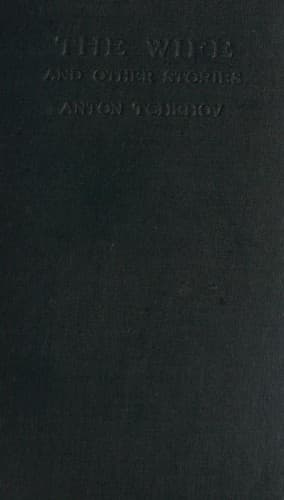
The Wife, and Other StoriesChekhov, Anton Pavlovich
General
The Wife, and Other Stories
Chekhov, Anton Pavlovich
Chekhov, Anton Pavlovich, 1860-1904 -- Translations into English; Russia -- Social life and customs -- Fiction; Short stories
“I ought to go tonight by the evening train. I ought to have gone before;
I have missed a fortnight as it is. The lectures begin on the first of
September.”
“Well, go,” Shiryaev assented; “why are you lingering on here? Pack up
and go, and good luck to you.”
A minute passed in silence.
“He must have money for the journey, Yevgraf Ivanovitch,” the mother
observed in a low voice.
“Money? To be sure, you can’t go without money. Take it at once, since
you need it. You could have had it long ago!”
The student heaved a faint sigh and looked with relief at his mother.
Deliberately Shiryaev took a pocket-book out of his coat-pocket and put
on his spectacles.
“How much do you want?” he asked.
“The fare to Moscow is eleven roubles forty-two kopecks....”
“Ah, money, money!” sighed the father. (He always sighed when he saw
money, even when he was receiving it.) “Here are twelve roubles for
you. You will have change out of that which will be of use to you on the
journey.”
“Thank you.”
After waiting a little, the student said:
“I did not get lessons quite at first last year. I don’t know how it
will be this year; most likely it will take me a little time to find
work. I ought to ask you for fifteen roubles for my lodging and dinner.”
Shiryaev thought a little and heaved a sigh.
“You will have to make ten do,” he said. “Here, take it.”
The student thanked him. He ought to have asked him for something more,
for clothes, for lecture fees, for books, but after an intent look at
his father he decided not to pester him further.
The mother, lacking in diplomacy and prudence, like all mothers, could
not restrain herself, and said:
“You ought to give him another six roubles, Yevgraf Ivanovitch, for a
pair of boots. Why, just see, how can he go to Moscow in such wrecks?”
“Let him take my old ones; they are still quite good.”
“He must have trousers, anyway; he is a disgrace to look at.”
And immediately after that a storm-signal showed itself, at the sight of
which all the family trembled.
Shiryaev’s short, fat neck turned suddenly red as a beetroot. The colour
mounted slowly to his ears, from his ears to his temples, and by degrees
suffused his whole face. Yevgraf Ivanovitch shifted in his chair
and unbuttoned his shirt-collar to save himself from choking. He
was evidently struggling with the feeling that was mastering him. A
deathlike silence followed. The children held their breath. Fedosya
Semyonovna, as though she did not grasp what was happening to her
husband, went on:
“He is not a little boy now, you know; he is ashamed to go about without
clothes.”
Shiryaev suddenly jumped up, and with all his might flung down his fat
pocket-book in the middle of the table, so that a hunk of bread flew off
a plate. A revolting expression of anger, resentment, avarice--all mixed
together--flamed on his face.
“Take everything!” he shouted in an unnatural voice; “plunder me! Take
it all! Strangle me!”
Public-domain text, read in full here on John Shaqi.
Reviews
Reviews
No reviews yet
Be the first to share your thoughts on this work.
Join the Discussion
Join the discussion
Sign in to leave a comment or review.
Sign InorCreate an account