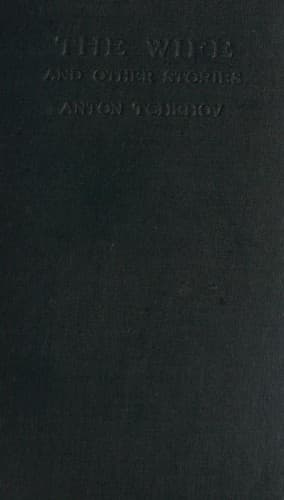
The Wife, and Other StoriesChekhov, Anton Pavlovich
General
The Wife, and Other Stories
Chekhov, Anton Pavlovich
Chekhov, Anton Pavlovich, 1860-1904 -- Translations into English; Russia -- Social life and customs -- Fiction; Short stories
My Excellency is conducted into the street, and seated in a cab. As I go
along, having nothing to do, I read the signboards from right to left.
The word “Traktir” reads “Ritkart”; that would just suit some baron’s
family: Baroness Ritkart. Farther on I drive through fields, by the
graveyard, which makes absolutely no impression on me, though I shall
soon lie in it; then I drive by forests and again by fields. There
is nothing of interest. After two hours of driving, my Excellency is
conducted into the lower storey of a summer villa and installed in a
small, very cheerful little room with light blue hangings.
At night there is sleeplessness as before, but in the morning I do not
put a good face upon it and listen to my wife, but lie in bed. I do not
sleep, but lie in the drowsy, half-conscious condition in which you know
you are not asleep, but dreaming. At midday I get up and from habit
sit down at my table, but I do not work now; I amuse myself with French
books in yellow covers, sent me by Katya. Of course, it would be more
patriotic to read Russian authors, but I must confess I cherish no
particular liking for them. With the exception of two or three of the
older writers, all our literature of today strikes me as not being
literature, but a special sort of home industry, which exists simply
in order to be encouraged, though people do not readily make use of
its products. The very best of these home products cannot be called
remarkable and cannot be sincerely praised without qualification. I must
say the same of all the literary novelties I have read during the last
ten or fifteen years; not one of them is remarkable, and not one of them
can be praised without a “but.” Cleverness, a good tone, but no talent;
talent, a good tone, but no cleverness; or talent, cleverness, but not a
good tone.
I don’t say the French books have talent, cleverness, and a good tone.
They don’t satisfy me, either. But they are not so tedious as the
Russian, and it is not unusual to find in them the chief element of
artistic creation--the feeling of personal freedom which is lacking in
the Russian authors. I don’t remember one new book in which the author
does not try from the first page to entangle himself in all sorts of
conditions and contracts with his conscience. One is afraid to speak of
the naked body; another ties himself up hand and foot in psychological
analysis; a third must have a “warm attitude to man”; a fourth purposely
scrawls whole descriptions of nature that he may not be suspected of
writing with a purpose.... One is bent upon being middle-class in his
work, another must be a nobleman, and so on. There is intentionalness,
circumspection, and self-will, but they have neither the independence
nor the manliness to write as they like, and therefore there is no
creativeness.
All this applies to what is called belles-lettres.
Public-domain text, read in full here on John Shaqi.
Reviews
Reviews
No reviews yet
Be the first to share your thoughts on this work.
Elsewhere in the archive
Join the Discussion
Join the discussion
Sign in to leave a comment or review.
Sign InorCreate an account