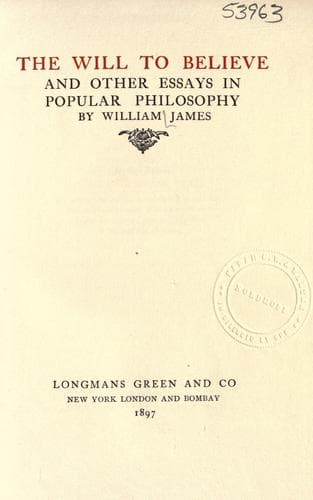
The Will to Believe, and Other Essays in Popular PhilosophyJames, William
Religion
The Will to Believe, and Other Essays in Popular Philosophy
James, William
Belief and doubt; Essays; Philosophy
These questions fan the fire of an unassuageable gnostic thirst, which
is as far removed from theism in one direction as agnosticism was
removed from it in the other; and which aspires to nothing less than an
absolute unity of knowledge with its object, and refuses to be
satisfied short of a fusion and solution and saturation of both
impression and action with reason, and {139} an absorption of all three
departments of the mind into one. Time would fail us to-day (even had
I the learning, which I have not) to speak of gnostic systems in
detail. The aim of all of them is to shadow forth a sort of process by
which spirit, emerging from its beginnings and exhausting the whole
circle of finite experience in its sweep, shall at last return and
possess itself as its own object at the climax of its career. This
climax is the religious consciousness. At the giddy height of this
conception, whose latest and best known form is the Hegelian
philosophy, definite words fail to serve their purpose; and the
ultimate goal,--where object and subject, worshipped and worshipper,
facts and the knowledge of them, fall into one, and where no other is
left outstanding beyond this one that alone is, and that we may call
indifferently act or fact, reality or idea, God or creation,--this
goal, I say, has to be adumbrated to our halting and gasping
intelligence by coarse physical metaphors, 'positings' and
'self-returnings' and 'removals' and 'settings free,' which hardly help
to make the matter clear.
But from the midst of the curdling and the circling of it all we seem
dimly to catch a glimpse of a state in which the reality to be known
and the power of knowing shall have become so mutually adequate that
each exhaustively is absorbed by the other and the twain become one
flesh, and in which the light shall somehow have soaked up all the
outer darkness into its own ubiquitous beams. Like all headlong
ideals, this apotheosis of the bare conceiving faculty has its depth
and wildness, its pang and its charm. To many it sings a truly siren
strain; and so long as it is held only as a postulate, as a mere
vanishing {140} point to give perspective to our intellectual aim, it
is hard to see any empirical title by which we may deny the legitimacy
of gnosticism's claims. That we are not as yet near the goal it
prefigures can never be a reason why we might not continue indefinitely
to approach it; and to all sceptical arguments, drawn from our reason's
actual finiteness, gnosticism can still oppose its indomitable faith in
the infinite character of its potential destiny.
Public-domain text, read in full here on John Shaqi.
Reviews
Reviews
No reviews yet
Be the first to share your thoughts on this work.
Elsewhere in the archive
Join the Discussion
Join the discussion
Sign in to leave a comment or review.
Sign InorCreate an account