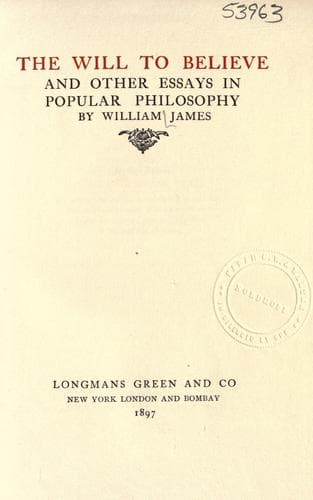
The Will to Believe, and Other Essays in Popular PhilosophyJames, William
Religion
The Will to Believe, and Other Essays in Popular Philosophy
James, William
Belief and doubt; Essays; Philosophy
Now, here it is that the physiologist's generalization, as it seems to
me, may fairly come in, and by ruling any such extravagant faith out of
court help to legitimate our personal mistrust of its pretensions. I
confess that I myself have always had a great mistrust of the
pretensions of the gnostic faith. Not only do I utterly fail to
understand what a cognitive faculty erected into the absolute of being,
with itself as its object, can mean; but even if we grant it a being
other than itself for object, I cannot reason myself out of the belief
that however familiar and at home we might become with the character of
that being, the bare being of it, the fact that it is there at all,
must always be something blankly given and presupposed in order that
conception may begin its work; must in short lie beyond speculation,
and not be enveloped in its sphere.
Accordingly, it is with no small pleasure that as a student of
physiology and psychology I find the only lesson I can learn from these
sciences to be one that corroborates these convictions. From its first
dawn to its highest actual attainment, we find that the cognitive
faculty, where it appears to exist at all, appears but as one element
in an organic mental whole, and as a minister to higher mental
powers,--the powers {141} of will. Such a thing as its emancipation
and absolution from these organic relations receives no faintest color
of plausibility from any fact we can discern. Arising as a part, in a
mental and objective world which are both larger than itself, it must,
whatever its powers of growth may be (and I am far from wishing to
disparage them), remain a part to the end. This is the character of
the cognitive element in all the mental life we know, and we have no
reason to suppose that that character will ever change. On the
contrary, it is more than probable that to the end of time our power of
moral and volitional response to the nature of things will be the
deepest organ of communication therewith we shall ever possess. In
every being that is real there is something external to, and sacred
from, the grasp of every other. God's being is sacred from ours. To
co-operate with his creation by the best and rightest response seems
all he wants of us. In such co-operation with his purposes, not in any
chimerical speculative conquest of him, not in any theoretic drinking
of him up, must lie the real meaning of our destiny.
Public-domain text, read in full here on John Shaqi.
Reviews
Reviews
No reviews yet
Be the first to share your thoughts on this work.
Elsewhere in the archive
Join the Discussion
Join the discussion
Sign in to leave a comment or review.
Sign InorCreate an account