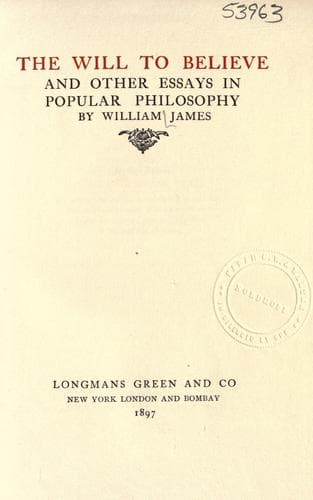
The Will to Believe, and Other Essays in Popular PhilosophyJames, William
Religion
The Will to Believe, and Other Essays in Popular Philosophy
James, William
Belief and doubt; Essays; Philosophy
[3] "No amount of failure in the attempt to subject the world of
sensible experience to a thorough-going system of conceptions, and to
bring all happenings back to cases of immutably valid law, is able to
shake our faith in the rightness of our principles. We hold fast to
our demand that even the greatest apparent confusion must sooner or
later solve itself in transparent formulas. We begin the work ever
afresh; and, refusing to believe that nature will permanently withhold
the reward of our exertions, think rather that we have hitherto only
failed to push them in the right direction. And all this pertinacity
flows from a conviction that we have no right to renounce the
fulfilment of our task. What, in short sustains the courage of
investigators is the force of obligation of an ethical idea."
(Sigwart: Logik, bd. ii., p. 23.)
This is a true account of the spirit of science. Does it essentially
differ from the spirit of religion? And is any one entitled to say in
advance, that, while the one form of faith shall be crowned with
success, the other is certainly doomed to fail?
[4] Concerning the transformation of the given order into the order of
conception, see S. H. Hodgson, The Philosophy of Reflection, chap. v.;
H. Lotze, Logik, sects. 342-351; C. Sigwart, Logik, sects. 60-63, 105.
[5] Haeckel has recently (Der Monismus, 1893, p. 37) proposed the
Cosmic Ether as a divinity fitted to reconcile science with theistic
faith.
[6] See the admirably original "Illustrations of the Logic of Science,"
by C. S. Peirce, especially the second paper, "How to make our Thoughts
clear," in the Popular Science Monthly for January, 1878.
[7] On this subject, see the preceding Essay.
[8] "As soon as it is recognized that our thought, as logic deals with
it, reposes on our _will to think_, the primacy of the will, even in
the theoretical sphere, must be conceded; and the last of
presuppositions is not merely [Kant's] that 'I think' must accompany
all my representations, but also that 'I will' must dominate all my
thinking." (Sigwart; Logik, ll. 25.)
[9] As our ancestors said, _Fiat justitia, pereat mundus_, so we, who
do not believe in justice or any absolute good, must, according to
these prophets, be willing to see the world perish, in order that
_scientia fiat_. Was there ever a more exquisite idol of the den, or
rather of the _shop_? In the clean sweep to be made of superstitions,
let the idol of stern obligation to be scientific go with the rest, and
people will have a fair chance to understand one another. But this
blowing of hot and of cold makes nothing but confusion.
[10] Especially the Essais de Critique Générale, 2me Edition, 6 vols.,
12mo, Paris, 1875; and the Esquisse d'une Classification Systématique
des Doctrines Philosophiques, 2 vols., 8vo, Paris, 1885.
{145}
THE DILEMMA OF DETERMINISM.[1]
Public-domain text, read in full here on John Shaqi.
Reviews
Reviews
No reviews yet
Be the first to share your thoughts on this work.
Elsewhere in the archive
Join the Discussion
Join the discussion
Sign in to leave a comment or review.
Sign InorCreate an account