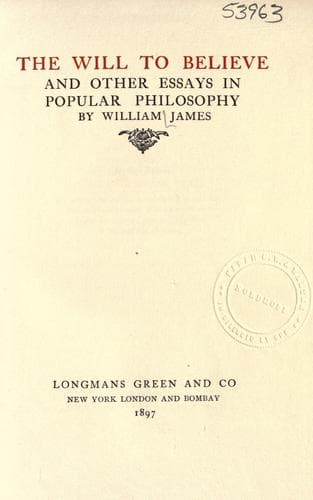
The Will to Believe, and Other Essays in Popular PhilosophyJames, William
Religion
The Will to Believe, and Other Essays in Popular Philosophy
James, William
Belief and doubt; Essays; Philosophy
A common opinion prevails that the juice has ages ago been pressed out
of the free-will controversy, and that no new champion can do more than
warm up stale arguments which every one has heard. This is a radical
mistake. I know of no subject less worn out, or in which inventive
genius has a better chance of breaking open new ground,--not, perhaps,
of forcing a conclusion or of coercing assent, but of deepening our
sense of what the issue between the two parties really is, of what the
ideas of fate and of free-will imply. At our very side almost, in the
past few years, we have seen falling in rapid succession from the press
works that present the alternative in entirely novel lights. Not to
speak of the English disciples of Hegel, such as Green and Bradley; not
to speak of Hinton and Hodgson, nor of Hazard here,--we see in the
writings of Renouvier, Fouillée, and Delboeuf[2] how completely changed
and refreshed is the form of all the old disputes. I cannot pretend to
vie in originality with any of the masters I have named, and my
ambition limits itself to just one little point. If I can make two of
the necessarily implied corollaries {146} of determinism clearer to you
than they have been made before, I shall have made it possible for you
to decide for or against that doctrine with a better understanding of
what you are about. And if you prefer not to decide at all, but to
remain doubters, you will at least see more plainly what the subject of
your hesitation is. I thus disclaim openly on the threshold all
pretension to prove to you that the freedom of the will is true. The
most I hope is to induce some of you to follow my own example in
assuming it true, and acting as if it were true. If it be true, it
seems to me that this is involved in the strict logic of the case. Its
truth ought not to be forced willy-nilly down our indifferent throats.
It ought to be freely espoused by men who can equally well turn their
backs upon it. In other words, our first act of freedom, if we are
free, ought in all inward propriety to be to affirm that we are free.
This should exclude, it seems to me, from the free-will side of the
question all hope of a coercive demonstration,--a demonstration which
I, for one, am perfectly contented to go without.
Public-domain text, read in full here on John Shaqi.
Reviews
Reviews
No reviews yet
Be the first to share your thoughts on this work.
Elsewhere in the archive
Join the Discussion
Join the discussion
Sign in to leave a comment or review.
Sign InorCreate an account