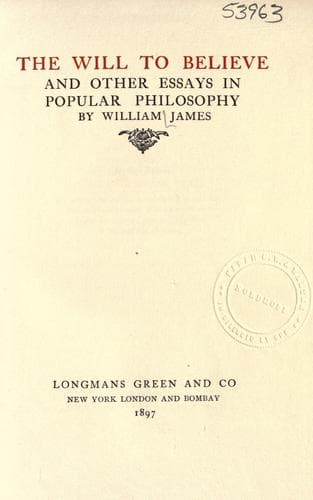
The Will to Believe, and Other Essays in Popular PhilosophyJames, William
Religion
The Will to Believe, and Other Essays in Popular Philosophy
James, William
Belief and doubt; Essays; Philosophy
To begin, then, I must suppose you acquainted with all the usual
arguments on the subject. I cannot stop to take up the old proofs from
causation, from statistics, from the certainty with which we can
foretell one another's conduct, from the fixity of character, and all
the rest. But there are two words which usually encumber these
classical arguments, {149} and which we must immediately dispose of if
we are to make any progress. One is the eulogistic word _freedom_, and
the other is the opprobrious word _chance_. The word 'chance' I wish
to keep, but I wish to get rid of the word 'freedom.' Its eulogistic
associations have so far overshadowed all the rest of its meaning that
both parties claim the sole right to use it, and determinists to-day
insist that they alone are freedom's champions. Old-fashioned
determinism was what we may call _hard_ determinism. It did not shrink
from such words as fatality, bondage of the will, necessitation, and
the like. Nowadays, we have a _soft_ determinism which abhors harsh
words, and, repudiating fatality, necessity, and even predetermination,
says that its real name is freedom; for freedom is only necessity
understood, and bondage to the highest is identical with true freedom.
Even a writer as little used to making capital out of soft words as Mr.
Hodgson hesitates not to call himself a 'free-will determinist.'
Now, all this is a quagmire of evasion under which the real issue of
fact has been entirely smothered. Freedom in all these senses presents
simply no problem at all. No matter what the soft determinist mean by
it,--whether he mean the acting without external constraint; whether he
mean the acting rightly, or whether he mean the acquiescing in the law
of the whole,--who cannot answer him that sometimes we are free and
sometimes we are not? But there _is_ a problem, an issue of fact and
not of words, an issue of the most momentous importance, which is often
decided without discussion in one sentence,--nay, in one clause of a
sentence,--by those very writers who spin out whole chapters in their
efforts to show {150} what 'true' freedom is; and that is the question
of determinism, about which we are to talk to-night.
Fortunately, no ambiguities hang about this word or about its opposite,
indeterminism. Both designate an outward way in which things may
happen, and their cold and mathematical sound has no sentimental
associations that can bribe our partiality either way in advance. Now,
evidence of an external kind to decide between determinism and
indeterminism is, as I intimated a while back, strictly impossible to
find. Let us look at the difference between them and see for
ourselves. What does determinism profess?
Public-domain text, read in full here on John Shaqi.
Reviews
Reviews
No reviews yet
Be the first to share your thoughts on this work.
Elsewhere in the archive
Join the Discussion
Join the discussion
Sign in to leave a comment or review.
Sign InorCreate an account