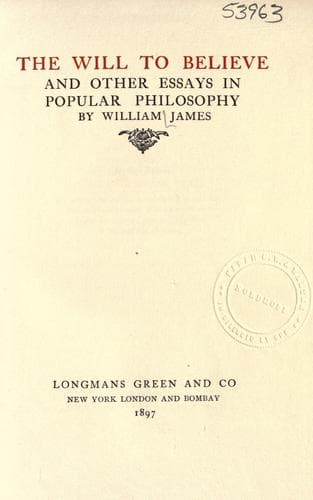
The Will to Believe, and Other Essays in Popular PhilosophyJames, William
Religion
The Will to Believe, and Other Essays in Popular Philosophy
James, William
Belief and doubt; Essays; Philosophy
With thus much understood at the outset, we can advance. But not
without one more point understood as well. The arguments I am about to
urge all proceed on two suppositions: first, when we make theories
about the world and discuss them with one another, we do so in order to
attain a conception of things which shall give us subjective
satisfaction; and, second, if there be two conceptions, and the one
seems to us, on the whole, more rational than the other, we are
entitled to suppose that the more rational one is the truer of the two.
I hope that you are all willing to make these suppositions with me;
{147} for I am afraid that if there be any of you here who are not,
they will find little edification in the rest of what I have to say. I
cannot stop to argue the point; but I myself believe that all the
magnificent achievements of mathematical and physical science--our
doctrines of evolution, of uniformity of law, and the rest--proceed
from our indomitable desire to cast the world into a more rational
shape in our minds than the shape into which it is thrown there by the
crude order of our experience. The world has shown itself, to a great
extent, plastic to this demand of ours for rationality. How much
farther it will show itself plastic no one can say. Our only means of
finding out is to try; and I, for one, feel as free to try conceptions
of moral as of mechanical or of logical rationality. If a certain
formula for expressing the nature of the world violates my moral
demand, I shall feel as free to throw it overboard, or at least to
doubt it, as if it disappointed my demand for uniformity of sequence,
for example; the one demand being, so far as I can see, quite as
subjective and emotional as the other is. The principle of causality,
for example,--what is it but a postulate, an empty name covering simply
a demand that the sequence of events shall some day manifest a deeper
kind of belonging of one thing with another than the mere arbitrary
juxtaposition which now phenomenally appears? It is as much an altar
to an unknown god as the one that Saint Paul found at Athens. All our
scientific and philosophic ideals are altars to unknown gods.
Uniformity is as much so as is free-will. If this be admitted, we can
debate on even terms. But if any one pretends that while freedom and
variety are, in the first instance, subjective demands, necessity and
uniformity are something {148} altogether different, I do not see how
we can debate at all.[3]
Public-domain text, read in full here on John Shaqi.
Reviews
Reviews
No reviews yet
Be the first to share your thoughts on this work.
Elsewhere in the archive
Join the Discussion
Join the discussion
Sign in to leave a comment or review.
Sign InorCreate an account