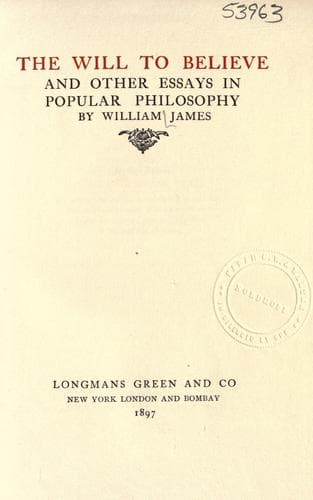
The Will to Believe, and Other Essays in Popular PhilosophyJames, William
Religion
The Will to Believe, and Other Essays in Popular Philosophy
James, William
Belief and doubt; Essays; Philosophy
The question relates solely to the existence of possibilities, in the
strict sense of the term, as things that may, but need not, be. Both
sides admit that a volition, for instance, has occurred. The
indeterminists say another volition might have occurred in its place;
the determinists swear that nothing could possibly {152} have occurred
in its place. Now, can science be called in to tell us which of these
two point-blank contradicters of each other is right? Science
professes to draw no conclusions but such as are based on matters of
fact, things that have actually happened; but how can any amount of
assurance that something actually happened give us the least grain of
information as to whether another thing might or might not have
happened in its place? Only facts can be proved by other facts. With
things that are possibilities and not facts, facts have no concern. If
we have no other evidence than the evidence of existing facts, the
possibility-question must remain a mystery never to be cleared up.
And the truth is that facts practically have hardly anything to do with
making us either determinists or indeterminists. Sure enough, we make
a flourish of quoting facts this way or that; and if we are
determinists, we talk about the infallibility with which we can predict
one another's conduct; while if we are indeterminists, we lay great
stress on the fact that it is just because we cannot foretell one
another's conduct, either in war or statecraft or in any of the great
and small intrigues and businesses of men, that life is so intensely
anxious and hazardous a game. But who does not see the wretched
insufficiency of this so-called objective testimony on both sides?
What fills up the gaps in our minds is something not objective, not
external. What divides us into possibility men and anti-possibility
men is different faiths or postulates,--postulates of rationality. To
this man the world seems more rational with possibilities in it,--to
that man more rational with possibilities excluded; and talk as we will
about having to yield to {153} evidence, what makes us monists or
pluralists, determinists or indeterminists, is at bottom always some
sentiment like this.
The stronghold of the deterministic sentiment is the antipathy to the
idea of chance. As soon as we begin to talk indeterminism to our
friends, we find a number of them shaking their heads. This notion of
alternative possibility, they say, this admission that any one of
several things may come to pass, is, after all, only a roundabout name
for chance; and chance is something the notion of which no sane mind
can for an instant tolerate in the world. What is it, they ask, but
barefaced crazy unreason, the negation of intelligibility and law? And
if the slightest particle of it exist anywhere, what is to prevent the
whole fabric from falling together, the stars from going out, and chaos
from recommencing her topsy-turvy reign?
Public-domain text, read in full here on John Shaqi.
Reviews
Reviews
No reviews yet
Be the first to share your thoughts on this work.
Elsewhere in the archive
Join the Discussion
Join the discussion
Sign in to leave a comment or review.
Sign InorCreate an account