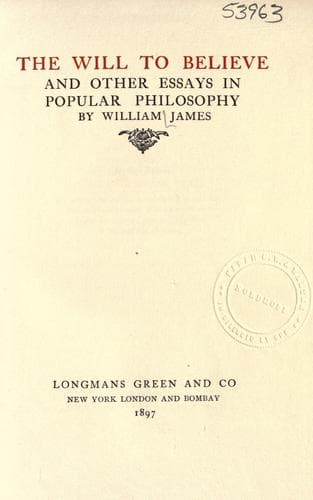
The Will to Believe, and Other Essays in Popular PhilosophyJames, William
Religion
The Will to Believe, and Other Essays in Popular Philosophy
James, William
Belief and doubt; Essays; Philosophy
Remarks of this sort about chance will put an end to discussion as
quickly as anything one can find. I have already told you that
'chance' was a word I wished to keep and use. Let us then examine
exactly what it means, and see whether it ought to be such a terrible
bugbear to us. I fancy that squeezing the thistle boldly will rob it
of its sting.
The sting of the word 'chance' seems to lie in the assumption that it
means something positive, and that if anything happens by chance, it
must needs be something of an intrinsically irrational and preposterous
sort. Now, chance means nothing of the kind. It is a purely negative
and relative term,[4] giving us {154} no information about that of
which it is predicated, except that it happens to be disconnected with
something else,--not controlled, secured, or necessitated by other
things in advance of its own actual presence. As this point is the
most subtile one of the whole lecture, and at the same time the point
on which all the rest hinges, I beg you to pay particular attention to
it. What I say is that it tells us nothing about what a thing may be
in itself to call it 'chance.' It may be a bad thing, it may be a good
thing. It may be lucidity, transparency, fitness incarnate, matching
the whole system of other things, when it has once befallen, in an
unimaginably perfect way. All you mean by calling it 'chance' is that
this is not guaranteed, that it may also fall out otherwise. For the
system of other things has no positive hold on the chance-thing. Its
origin is in a certain fashion negative: it escapes, and says, Hands
off! coming, when it comes, as a free gift, or not at all.
This negativeness, however, and this opacity of the chance-thing when
thus considered _ab. extra_, or from the point of view of previous
things or distant things, do not preclude its having any amount of
positiveness and luminosity from within, and at its own place and
moment. All that its chance-character asserts about it is that there
is something in it really of its own, something that is not the
unconditional property of the whole. If the whole wants this property,
the whole must wait till it can get it, if it be a matter of chance.
That the universe may actually be a sort of joint-stock society of this
sort, in which the sharers have both limited liabilities and limited
powers, is of course a simple and conceivable notion.
Public-domain text, read in full here on John Shaqi.
Reviews
Reviews
No reviews yet
Be the first to share your thoughts on this work.
Elsewhere in the archive
Join the Discussion
Join the discussion
Sign in to leave a comment or review.
Sign InorCreate an account