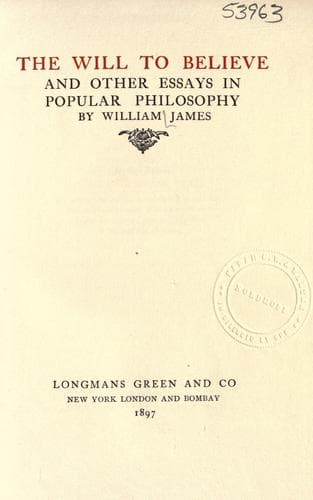
The Will to Believe, and Other Essays in Popular PhilosophyJames, William
Religion
The Will to Believe, and Other Essays in Popular Philosophy
James, William
Belief and doubt; Essays; Philosophy
a dogma and based on no insight into details. Before my choice, either
street seemed as natural to you as to me. Had I happened to take
Oxford Street, Divinity Avenue would have figured in your philosophy as
the gap in nature; and you would have so proclaimed it with the best
deterministic conscience in the world.
But what a hollow outcry, then, is this against a chance which, if it
were present to us, we could by no character whatever distinguish from
a rational necessity! I have taken the most trivial of examples, but
no possible example could lead to any different {157} result. For what
are the alternatives which, in point of fact, offer themselves to human
volition? What are those futures that now seem matters of chance? Are
they not one and all like the Divinity Avenue and Oxford Street of our
example? Are they not all of them _kinds_ of things already here and
based in the existing frame of nature? Is any one ever tempted to
produce an _absolute_ accident, something utterly irrelevant to the
rest of the world? Do not all the motives that assail us, all the
futures that offer themselves to our choice, spring equally from the
soil of the past; and would not either one of them, whether realized
through chance or through necessity, the moment it was realized, seem
to us to fit that past, and in the completest and most continuous
manner to interdigitate with the phenomena already there?[5]
The more one thinks of the matter, the more one wonders that so empty
and gratuitous a hubbub as this outcry against chance should have found
so great an echo in the hearts of men. It is a word which tells us
absolutely nothing about what chances, or about the _modus operandi_ of
the chancing; and the use of it as a war-cry shows only a temper of
{158} intellectual absolutism, a demand that the world shall be a solid
block, subject to one control,--which temper, which demand, the world
may not be bound to gratify at all. In every outwardly verifiable and
practical respect, a world in which the alternatives that now actually
distract _your_ choice were decided by pure chance would be by _me_
absolutely undistinguished from the world in which I now live. I am,
therefore, entirely willing to call it, so far as your choices go, a
world of chance for me. To _yourselves_, it is true, those very acts
of choice, which to me are so blind, opaque, and external, are the
opposites of this, for you are within them and effect them. To you
they appear as decisions; and decisions, for him who makes them, are
altogether peculiar psychic facts. Self-luminous and self-justifying
at the living moment at which they occur, they appeal to no outside
moment to put its stamp upon them or make them continuous with the rest
of nature. Themselves it is rather who seem to make nature continuous;
and in their strange and intense function of granting consent to one
possibility and withholding it from another, to transform an equivocal
Public-domain text, read in full here on John Shaqi.
Reviews
Reviews
No reviews yet
Be the first to share your thoughts on this work.
Elsewhere in the archive
Join the Discussion
Join the discussion
Sign in to leave a comment or review.
Sign InorCreate an account