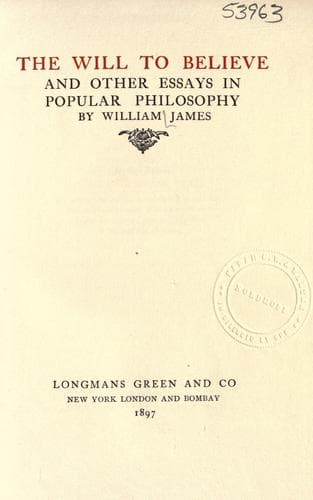
The Will to Believe, and Other Essays in Popular PhilosophyJames, William
Religion
The Will to Believe, and Other Essays in Popular Philosophy
James, William
Belief and doubt; Essays; Philosophy
Nevertheless, many persons talk as if the minutest {155} dose of
disconnectedness of one part with another, the smallest modicum of
independence, the faintest tremor of ambiguity about the future, for
example, would ruin everything, and turn this goodly universe into a
sort of insane sand-heap or nulliverse, no universe at all. Since
future human volitions are as a matter of fact the only ambiguous
things we are tempted to believe in, let us stop for a moment to make
ourselves sure whether their independent and accidental character need
be fraught with such direful consequences to the universe as these.
What is meant by saying that my choice of which way to walk home after
the lecture is ambiguous and matter of chance as far as the present
moment is concerned? It means that both Divinity Avenue and Oxford
Street are called; but that only one, and that one _either_ one, shall
be chosen. Now, I ask you seriously to suppose that this ambiguity of
my choice is real; and then to make the impossible hypothesis that the
choice is made twice over, and each time falls on a different street.
In other words, imagine that I first walk through Divinity Avenue, and
then imagine that the powers governing the universe annihilate ten
minutes of time with all that it contained, and set me back at the door
of this hall just as I was before the choice was made. Imagine then
that, everything else being the same, I now make a different choice and
traverse Oxford Street. You, as passive spectators, look on and see
the two alternative universes,--one of them with me walking through
Divinity Avenue in it, the other with the same me walking through
Oxford Street. Now, if you are determinists you believe one of these
universes to have been from eternity impossible: you believe it to have
{156} been impossible because of the intrinsic irrationality or
accidentality somewhere involved in it. But looking outwardly at these
universes, can you say which is the impossible and accidental one, and
which the rational and necessary one? I doubt if the most iron-clad
determinist among you could have the slightest glimmer of light on this
point. In other words, either universe _after the fact_ and once there
would, to our means of observation and understanding, appear just as
rational as the other. There would be absolutely no criterion by which
we might judge one necessary and the other matter of chance. Suppose
now we relieve the gods of their hypothetical task and assume my
choice, once made, to be made forever. I go through Divinity Avenue
for good and all. If, as good determinists, you now begin to affirm,
what all good determinists punctually do affirm, that in the nature of
things I _couldn't_ have gone through Oxford Street,--had I done so it
would have been chance, irrationality, insanity, a horrid gap in
nature,--I simply call your attention to this, that your affirmation is
what the Germans call a _Machtspruch_, a mere conception fulminated as
Public-domain text, read in full here on John Shaqi.
Reviews
Reviews
No reviews yet
Be the first to share your thoughts on this work.
Elsewhere in the archive
Join the Discussion
Join the discussion
Sign in to leave a comment or review.
Sign InorCreate an account