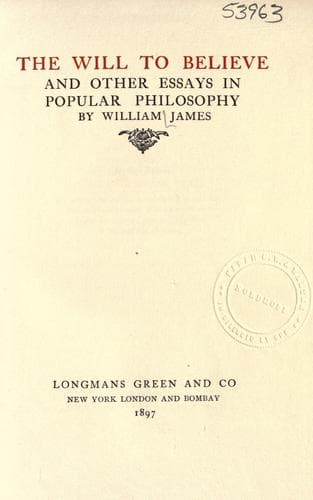
The Will to Believe, and Other Essays in Popular PhilosophyJames, William
Religion
The Will to Believe, and Other Essays in Popular Philosophy
James, William
Belief and doubt; Essays; Philosophy
Look at the last runnings of the romantic school, as we see them in
that strange contemporary Parisian literature, with which we of the
less clever countries are so often driven to rinse out our minds after
they have become clogged with the dulness and heaviness of our native
pursuits. The romantic school began with the worship of subjective
sensibility and the revolt against legality of which Rousseau was the
first great prophet: and through various fluxes and refluxes, right
wings and left wings, it stands to-day with two men of genius, M. Renan
and M. Zola, as its principal exponents,--one speaking with its
masculine, and the other with what might be called its feminine, voice.
I prefer not to think now of less noble members of the school, and the
Renan I have in mind is of course the Renan of latest dates. As I have
used the term gnostic, both he and Zola are gnostics of the most
pronounced sort. Both are athirst for the facts of life, and both
think the facts of human sensibility to be of all facts the most worthy
of attention. Both agree, moreover, that sensibility seems to be there
for no higher purpose,--certainly not, as the Philistines say, for the
sake of bringing mere outward rights to pass and frustrating outward
wrongs. One dwells on the sensibilities for their energy, the other
for their sweetness; one speaks with a voice of {173} bronze, the other
with that of an Æolian harp; one ruggedly ignores the distinction of
good and evil, the other plays the coquette between the craven
unmanliness of his Philosophic Dialogues and the butterfly optimism of
his Souvenirs de Jeunesse. But under the pages of both there sounds
incessantly the hoarse bass of _vanitas vanitatum, omnia vanitas_,
which the reader may hear, whenever he will, between the lines. No
writer of this French romantic school has a word of rescue from the
hour of satiety with the things of life,--the hour in which we say, "I
take no pleasure in them,"--or from the hour of terror at the world's
vast meaningless grinding, if perchance such hours should come. For
terror and satiety are facts of sensibility like any others; and at
their own hour they reign in their own right. The heart of the
romantic utterances, whether poetical, critical, or historical, is this
inward remedilessness, what Carlyle calls this far-off whimpering of
wail and woe. And from this romantic state of mind there is absolutely
no possible _theoretic_ escape. Whether, like Renan, we look upon life
in a more refined way, as a romance of the spirit; or whether, like the
friends of M. Zola, we pique ourselves on our 'scientific' and
'analytic' character, and prefer to be cynical, and call the world a
'roman experimental' on an infinite scale,--in either case the world
appears to us potentially as what the same Carlyle once called it, a
vast, gloomy, solitary Golgotha and mill of death.
Public-domain text, read in full here on John Shaqi.
Reviews
Reviews
No reviews yet
Be the first to share your thoughts on this work.
Elsewhere in the archive
Join the Discussion
Join the discussion
Sign in to leave a comment or review.
Sign InorCreate an account