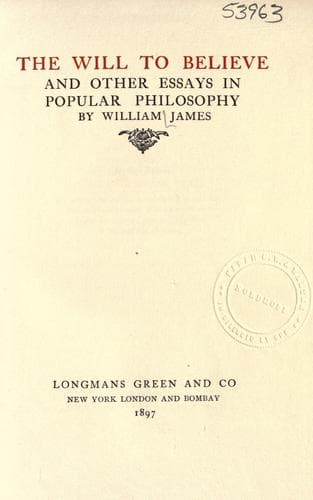
The Will to Believe, and Other Essays in Popular PhilosophyJames, William
Religion
The Will to Believe, and Other Essays in Popular Philosophy
James, William
Belief and doubt; Essays; Philosophy
The only escape is by the practical way. And since I have mentioned
the nowadays much-reviled name of Carlyle, let me mention it once more,
and say it is the way of his teaching. No matter for Carlyle's life,
no matter for a great deal of his {174} writing. What was the most
important thing he said to us? He said: "Hang your sensibilities!
Stop your snivelling complaints, and your equally snivelling raptures!
Leave off your general emotional tomfoolery, and get to WORK like men!"
But this means a complete rupture with the subjectivist philosophy of
things. It says conduct, and not sensibility, is the ultimate fact for
our recognition. With the vision of certain works to be done, of
certain outward changes to be wrought or resisted, it says our
intellectual horizon terminates. No matter how we succeed in doing
these outward duties, whether gladly and spontaneously, or heavily and
unwillingly, do them we somehow must; for the leaving of them undone is
perdition. No matter how we feel; if we are only faithful in the
outward act and refuse to do wrong, the world will in so far be safe,
and we quit of our debt toward it. Take, then, the yoke upon our
shoulders; bend our neck beneath the heavy legality of its weight;
regard something else than our feeling as our limit, our master, and
our law; be willing to live and die in its service,--and, at a stroke,
we have passed from the subjective into the objective philosophy of
things, much as one awakens from some feverish dream, full of bad
lights and noises, to find one's self bathed in the sacred coolness and
quiet of the air of the night.
But what is the essence of this philosophy of objective conduct, so
old-fashioned and finite, but so chaste and sane and strong, when
compared with its romantic rival? It is the recognition of limits,
foreign and opaque to our understanding. It is the willingness, after
bringing about some external good, to feel at peace; for our
responsibility ends with the {175} performance of that duty, and the
burden of the rest we may lay on higher powers.[9]
"Look to thyself, O Universe,
Thou art better and not worse,"
we may say in that philosophy, the moment we have done our stroke of
conduct, however small. For in the view of that philosophy the
universe belongs to a plurality of semi-independent forces, each one of
which may help or hinder, and be helped or hindered by, the operations
of the rest.
Public-domain text, read in full here on John Shaqi.
Reviews
Reviews
No reviews yet
Be the first to share your thoughts on this work.
Elsewhere in the archive
Join the Discussion
Join the discussion
Sign in to leave a comment or review.
Sign InorCreate an account