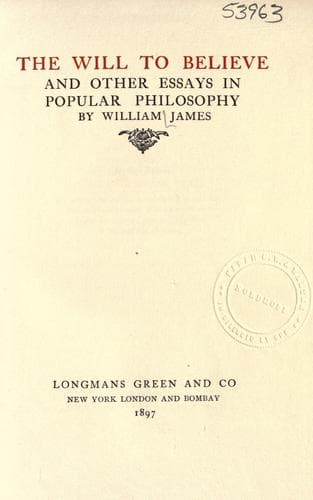
The Will to Believe, and Other Essays in Popular PhilosophyJames, William
Religion
The Will to Believe, and Other Essays in Popular Philosophy
James, William
Belief and doubt; Essays; Philosophy
Let me, then, without circumlocution say just this. The world is
enigmatical enough in all conscience, whatever theory we may take up
toward it. The indeterminism I defend, the free-will theory of popular
sense based on the judgment of regret, represents {177} that world as
vulnerable, and liable to be injured by certain of its parts if they
act wrong. And it represents their acting wrong as a matter of
possibility or accident, neither inevitable nor yet to be infallibly
warded off. In all this, it is a theory devoid either of transparency
or of stability. It gives us a pluralistic, restless universe, in
which no single point of view can ever take in the whole scene; and to
a mind possessed of the love of unity at any cost, it will, no doubt,
remain forever inacceptable. A friend with such a mind once told me
that the thought of my universe made him sick, like the sight of the
horrible motion of a mass of maggots in their carrion bed.
But while I freely admit that the pluralism and the restlessness are
repugnant and irrational in a certain way, I find that every
alternative to them is irrational in a deeper way. The indeterminism
with its maggots, if you please to speak so about it, offends only the
native absolutism of my intellect,--an absolutism which, after all,
perhaps, deserves to be snubbed and kept in check. But the determinism
with its necessary carrion, to continue the figure of speech, and with
no possible maggots to eat the latter up, violates my sense of moral
reality through and through. When, for example, I imagine such carrion
as the Brockton murder, I cannot conceive it as an act by which the
universe, as a whole, logically and necessarily expresses its nature
without shrinking from complicity with such a whole. And I
deliberately refuse to keep on terms of loyalty with the universe by
saying blankly that the murder, since it does flow from the nature of
the whole, is not carrion. There are some instinctive reactions which
{178} I, for one, will not tamper with. The only remaining
alternative, the attitude of gnostical romanticism, wrenches my
personal instincts in quite as violent a way. It falsifies the simple
objectivity of their deliverance. It makes the goose-flesh the murder
excites in me a sufficient reason for the perpetration of the crime.
It transforms life from a tragic reality into an insincere melodramatic
exhibition, as foul or as tawdry as any one's diseased curiosity
pleases to carry it out. And with its consecration of the 'roman
naturaliste' state of mind, and its enthronement of the baser crew of
Parisian _littérateurs_ among the eternally indispensable organs by
which the infinite spirit of things attains to that subjective
illumination which is the task of its life, it leaves me in presence of
a sort of subjective carrion considerably more noisome than the
objective carrion I called it in to take away.
Public-domain text, read in full here on John Shaqi.
Reviews
Reviews
No reviews yet
Be the first to share your thoughts on this work.
Elsewhere in the archive
Join the Discussion
Join the discussion
Sign in to leave a comment or review.
Sign InorCreate an account