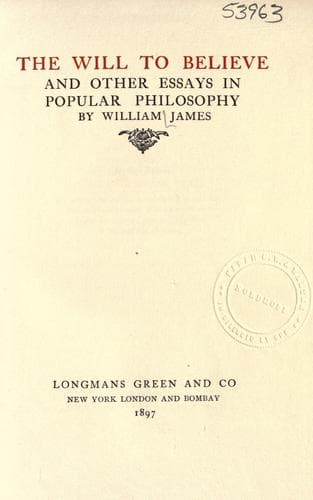
The Will to Believe, and Other Essays in Popular PhilosophyJames, William
Religion
The Will to Believe, and Other Essays in Popular Philosophy
James, William
Belief and doubt; Essays; Philosophy
But this brings us right back, after such a long detour, to the
question of indeterminism and to the conclusion of all I came here to
say to-night. For the only consistent way of representing a pluralism
and a world whose parts may affect one another through their conduct
being either good or bad is the indeterministic way. What interest,
zest, or excitement can there be in achieving the right way, unless we
are enabled to feel that the wrong way is also a possible and a natural
way,--nay, more, a menacing and an imminent way? And what sense can
there be in condemning ourselves for taking the wrong way, unless we
need have done nothing of the sort, unless the right way was open to us
as well? I cannot understand the willingness to act, no matter how we
feel, without the belief that acts are really good and bad. I cannot
understand the belief that an act is bad, without regret at its
happening. I cannot understand regret without the admission of real,
genuine possibilities in the world. Only _then_ is it {176} other than
a mockery to feel, after we have failed to do our best, that an
irreparable opportunity is gone from the universe, the loss of which it
must forever after mourn.
If you insist that this is all superstition, that possibility is in the
eye of science and reason impossibility, and that if I act badly 'tis
that the universe was foredoomed to suffer this defect, you fall right
back into the dilemma, the labyrinth, of pessimism and subjectivism,
from out of whose toils we have just wound our way.
Now, we are of course free to fall back, if we please. For my own
part, though, whatever difficulties may beset the philosophy of
objective right and wrong, and the indeterminism it seems to imply,
determinism, with its alternative of pessimism or romanticism, contains
difficulties that are greater still. But you will remember that I
expressly repudiated awhile ago the pretension to offer any arguments
which could be coercive in a so-called scientific fashion in this
matter. And I consequently find myself, at the end of this long talk,
obliged to state my conclusions in an altogether personal way. This
personal method of appeal seems to be among the very conditions of the
problem; and the most any one can do is to confess as candidly as he
can the grounds for the faith that is in him, and leave his example to
work on others as it may.
Public-domain text, read in full here on John Shaqi.
Reviews
Reviews
No reviews yet
Be the first to share your thoughts on this work.
Elsewhere in the archive
Join the Discussion
Join the discussion
Sign in to leave a comment or review.
Sign InorCreate an account