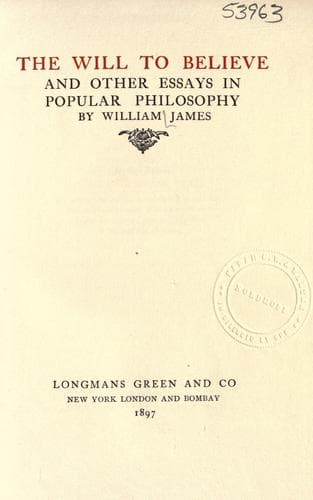
The Will to Believe, and Other Essays in Popular PhilosophyJames, William
Religion
The Will to Believe, and Other Essays in Popular Philosophy
James, William
Belief and doubt; Essays; Philosophy
It is only our already dead hypotheses that our willing nature is
unable to bring to life again But what has made them dead for us is
for the most part {9} a previous action of our willing nature of an
antagonistic kind. When I say 'willing nature,' I do not mean only
such deliberate volitions as may have set up habits of belief that we
cannot now escape from,--I mean all such factors of belief as fear and
hope, prejudice and passion, imitation and partisanship, the
circumpressure of our caste and set. As a matter of fact we find
ourselves believing, we hardly know how or why. Mr. Balfour gives the
name of 'authority' to all those influences, born of the intellectual
climate, that make hypotheses possible or impossible for us, alive or
dead. Here in this room, we all of us believe in molecules and the
conservation of energy, in democracy and necessary progress, in
Protestant Christianity and the duty of fighting for 'the doctrine of
the immortal Monroe,' all for no reasons worthy of the name. We see
into these matters with no more inner clearness, and probably with much
less, than any disbeliever in them might possess. His
unconventionality would probably have some grounds to show for its
conclusions; but for us, not insight, but the _prestige_ of the
opinions, is what makes the spark shoot from them and light up our
sleeping magazines of faith. Our reason is quite satisfied, in nine
hundred and ninety-nine cases out of every thousand of us, if it can
find a few arguments that will do to recite in case our credulity is
criticised by some one else. Our faith is faith in some one else's
faith, and in the greatest matters this is most the case. Our belief
in truth itself, for instance, that there is a truth, and that our
minds and it are made for each other,--what is it but a passionate
affirmation of desire, in which our social system backs us up? We want
to have a truth; we want to believe that our {10} experiments and
studies and discussions must put us in a continually better and better
position towards it; and on this line we agree to fight out our
thinking lives. But if a pyrrhonistic sceptic asks us _how we know_
all this, can our logic find a reply? No! certainly it cannot. It is
just one volition against another,--we willing to go in for life upon a
trust or assumption which he, for his part, does not care to make.[2]
Public-domain text, read in full here on John Shaqi.
Reviews
Reviews
No reviews yet
Be the first to share your thoughts on this work.
Join the Discussion
Join the discussion
Sign in to leave a comment or review.
Sign InorCreate an account