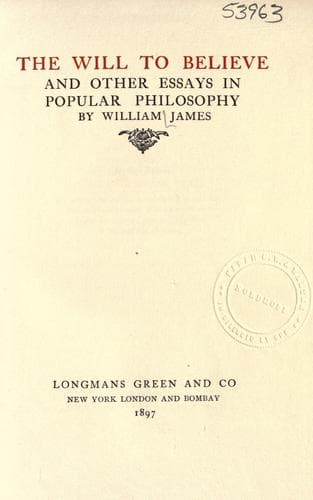
The Will to Believe, and Other Essays in Popular PhilosophyJames, William
Religion
The Will to Believe, and Other Essays in Popular Philosophy
James, William
Belief and doubt; Essays; Philosophy
[2] And I may now say Charles S. Peirce,--see the Monist, for 1892-93.
[3] "The whole history of popular beliefs about Nature refutes the
notion that the thought of a universal physical order can possibly have
arisen from the purely passive reception and association of particular
perceptions. Indubitable as it is that men infer from known cases to
unknown, it is equally certain that this procedure, if restricted to
the phenomenal materials that spontaneously offer themselves, would
never have led to the belief in a general uniformity, but only to the
belief that law and lawlessness rule the world in motley alternation.
From the point of view of strict experience, nothing exists but the sum
of particular perceptions, with their coincidences on the one hand,
their contradictions on the other.
"That there is more order in the world than appears at first sight is
not discovered; _till the order is looked for_. The first impulse to
look for it proceeds from practical needs: where ends must be attained,
or produce a result. But the practical need is only the first occasion
for our reflection on the conditions of true knowledge; and even were
there no such need, motives would still be present for carrying us
beyond the stage of mere association. For not with an equal interest,
or rather with an equal lack of interest, does man contemplate those
natural processes in which a thing is linked with its former mate, and
those in which it is linked to something else. _The former processes
harmonize with the conditions of his own thinking_: the latter do not.
In the former, his _concepts_, _general judgments_, and _inferences_
apply to reality: in the latter, they have no such application. And
thus the intellectual satisfaction which at first comes to him without
reflection, at last excites in him the conscious wish to find realized
throughout the entire phenomenal world those rational continuities,
uniformities, and necessities which are the fundamental element and
guiding principle of his own thought." (Sigwart, Logik, bd. 3, s. 382.)
[4] Speaking technically, it is a word with a positive denotation, but
a connotation that is negative. Other things must be silent about
_what_ it is: it alone can decide that point at the moment in which it
reveals itself.
Public-domain text, read in full here on John Shaqi.
Reviews
Reviews
No reviews yet
Be the first to share your thoughts on this work.
Elsewhere in the archive
Join the Discussion
Join the discussion
Sign in to leave a comment or review.
Sign InorCreate an account