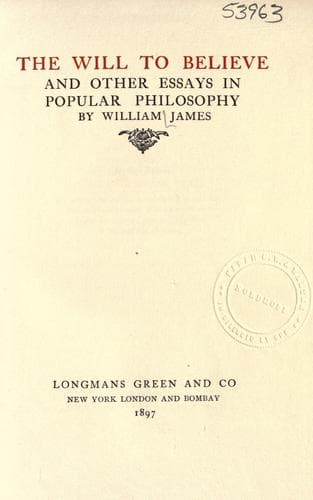
The Will to Believe, and Other Essays in Popular PhilosophyJames, William
Religion
The Will to Believe, and Other Essays in Popular Philosophy
James, William
Belief and doubt; Essays; Philosophy
[5] A favorite argument against free-will is that if it be true, a
man's murderer may as probably be his best friend as his worst enemy, a
mother be as likely to strangle as to suckle her first-born, and all of
us be as ready to jump from fourth-story windows as to go out of front
doors, etc. Users of this argument should properly be excluded from
debate till they learn what the real question is. 'Free-will' does not
say that everything that is physically conceivable is also morally
possible. It merely says that of alternatives that really _tempt_ our
will more than one is really possible. Of course, the alternatives
that do thus tempt our will are vastly fewer than the physical
possibilities we can coldly fancy. Persons really tempted often do
murder their best friends, mothers do strangle their first-born, people
do jump out of fourth-story windows, etc.
[6] To a reader who says he is satisfied with a pessimism, and has no
objection to thinking the whole bad, I have no more to say: he makes
fewer demands on the world than I, who, making them, wish to look a
little further before I give up all hope of having them satisfied. If,
however, all he means is that the badness of some parts does not
prevent his acceptance of a universe whose _other_ parts give him
satisfaction, I welcome him as an ally. He has abandoned the notion of
the _Whole_, which is the essence of deterministic monism, and views
things as a pluralism, just as I do in this paper.
[7] Compare Sir James Stephen's Essays by a Barrister, London, 1862,
pp. 138, 318.
[8] Cet univers est un spectacle que Dieu se donne à lui-même. Servons
les intentions du grand chorège en contribuant à rendre le spectacle
aussi brillant, aussi varié que possible.--RENAN.
[9] The burden, for example, of seeing to it that the _end_ of all our
righteousness be some positive universal gain.
[10] This of course leaves the creative mind subject to the law of
time. And to any one who insists on the timelessness of that mind I
have no reply to make. A mind to whom all time is simultaneously
present must see all things under the form of actuality, or under some
form to us unknown. If he thinks certain moments as ambiguous in their
content while future, he must simultaneously know how the ambiguity
will have been decided when they are past. So that none of his mental
judgments can possibly be called hypothetical, and his world is one
from which chance is excluded. Is not, however, the timeless mind
rather a gratuitous fiction? And is not the notion of eternity being
given at a stroke to omniscience only just another way of whacking upon
us the block-universe, and of denying that possibilities exist?--just
the point to be proved. To say that time is an illusory appearance is
only a roundabout manner of saying there is no real plurality, and that
the frame of things is an absolute unit. Admit plurality, and time may
be its form.
Public-domain text, read in full here on John Shaqi.
Reviews
Reviews
No reviews yet
Be the first to share your thoughts on this work.
Elsewhere in the archive
Join the Discussion
Join the discussion
Sign in to leave a comment or review.
Sign InorCreate an account