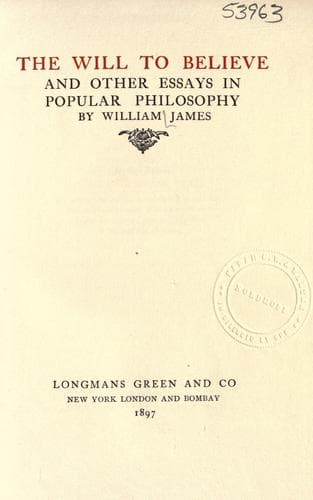
The Will to Believe, and Other Essays in Popular PhilosophyJames, William
Religion
The Will to Believe, and Other Essays in Popular Philosophy
James, William
Belief and doubt; Essays; Philosophy
First of all, what is the position of him who seeks an ethical
philosophy? To begin with, he must be distinguished from all those who
are satisfied to be ethical sceptics. He _will_ not be a sceptic;
therefore so far from ethical scepticism being one possible fruit of
ethical philosophizing, it can only be regarded as that residual
alternative to all philosophy which from the outset menaces every
would-be philosopher who may give up the quest discouraged, and
renounce his original aim. That aim is to find an account of the moral
relations that obtain among things, which {185} will weave them into
the unity of a stable system, and make of the world what one may call a
genuine universe from the ethical point of view. So far as the world
resists reduction to the form of unity, so far as ethical propositions
seem unstable, so far does the philosopher fail of his ideal. The
subject-matter of his study is the ideals he finds existing in the
world; the purpose which guides him is this ideal of his own, of
getting them into a certain form. This ideal is thus a factor in
ethical philosophy whose legitimate presence must never be overlooked;
it is a positive contribution which the philosopher himself necessarily
makes to the problem. But it is his only positive contribution. At
the outset of his inquiry he ought to have no other ideals. Were he
interested peculiarly in the triumph of any one kind of good, he would
_pro tanto_ cease to be a judicial investigator, and become an advocate
for some limited element of the case.
There are three questions in ethics which must be kept apart. Let them
be called respectively the _psychological_ question, the _metaphysical_
question, and the _casuistic_ question. The psychological question
asks after the historical _origin_ of our moral ideas and judgments;
the metaphysical question asks what the very _meaning_ of the words
'good,' 'ill,' and 'obligation' are; the casuistic question asks what
is the _measure_ of the various goods and ills which men recognize, so
that the philosopher may settle the true order of human obligations.
I.
Public-domain text, read in full here on John Shaqi.
Reviews
Reviews
No reviews yet
Be the first to share your thoughts on this work.
Elsewhere in the archive
Join the Discussion
Join the discussion
Sign in to leave a comment or review.
Sign InorCreate an account