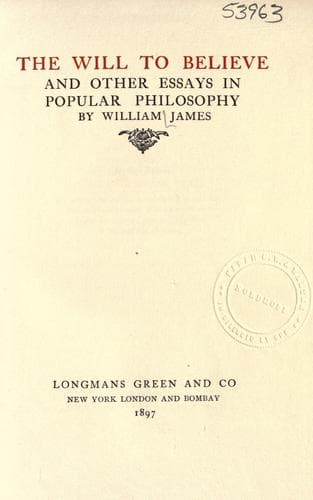
The Will to Believe, and Other Essays in Popular PhilosophyJames, William
Religion
The Will to Believe, and Other Essays in Popular Philosophy
James, William
Belief and doubt; Essays; Philosophy
The psychological question is for most disputants the only question.
When your ordinary doctor of {186} divinity has proved to his own
satisfaction that an altogether unique faculty called 'conscience' must
be postulated to tell us what is right and what is wrong; or when your
popular-science enthusiast has proclaimed that 'apriorism' is an
exploded superstition, and that our moral judgments have gradually
resulted from the teaching of the environment, each of these persons
thinks that ethics is settled and nothing more is to be said. The
familiar pair of names, Intuitionist and Evolutionist, so commonly used
now to connote all possible differences in ethical opinion, really
refer to the psychological question alone. The discussion of this
question hinges so much upon particular details that it is impossible
to enter upon it at all within the limits of this paper. I will
therefore only express dogmatically my own belief, which is this,--that
the Benthams, the Mills, and the Barns have done a lasting service in
taking so many of our human ideals and showing how they must have
arisen from the association with acts of simple bodily pleasures and
reliefs from pain. Association with many remote pleasures will
unquestionably make a thing significant of goodness in our minds; and
the more vaguely the goodness is conceived of, the more mysterious will
its source appear to be. But it is surely impossible to explain all
our sentiments and preferences in this simple way. The more minutely
psychology studies human nature, the more clearly it finds there traces
of secondary affections, relating the impressions of the environment
with one another and with our impulses in quite different ways from
those mere associations of coexistence and succession which are
practically all that pure empiricism can admit. Take the love of
drunkenness; take bashfulness, the terror {187} of high places, the
tendency to sea-sickness, to faint at the sight of blood, the
susceptibility to musical sounds; take the emotion of the comical, the
passion for poetry, for mathematics, or for metaphysics,--no one of
these things can be wholly explained by either association or utility.
They _go with_ other things that can be so explained, no doubt; and
some of them are prophetic of future utilities, since there is nothing
in us for which some use may not be found. But their origin is in
incidental complications to our cerebral structure, a structure whose
original features arose with no reference to the perception of such
discords and harmonies as these.
Public-domain text, read in full here on John Shaqi.
Reviews
Reviews
No reviews yet
Be the first to share your thoughts on this work.
Elsewhere in the archive
Join the Discussion
Join the discussion
Sign in to leave a comment or review.
Sign InorCreate an account