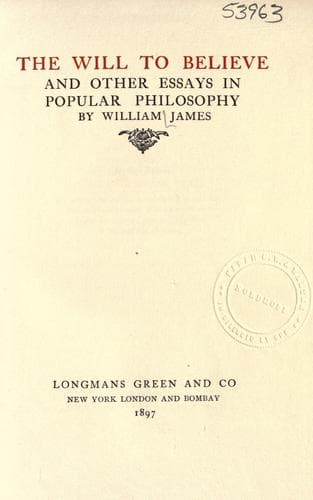
The Will to Believe, and Other Essays in Popular PhilosophyJames, William
Religion
The Will to Believe, and Other Essays in Popular Philosophy
James, William
Belief and doubt; Essays; Philosophy
Their only habitat can be a mind which feels them; and no
world composed of merely physical facts can possibly be a world to
which ethical propositions apply.
The moment one sentient being, however, is made a part of the universe,
there is a chance for goods and evils really to exist. Moral relations
now have their _status_, in that being's consciousness. So far as he
feels anything to be good, he _makes_ it good. It {191} _is_ good, for
him; and being good for him, is absolutely good, for he is the sole
creator of values in that universe, and outside of his opinion things
have no moral character at all.
In such a universe as that it would of course be absurd to raise the
question of whether the solitary thinker's judgments of good and ill
are true or not. Truth supposes a standard outside of the thinker to
which he must conform; but here the thinker is a sort of divinity,
subject to no higher judge. Let us call the supposed universe which he
inhabits a _moral solitude_. In such a moral solitude it is clear that
there can be no outward obligation, and that the only trouble the
god-like thinker is liable to have will be over the consistency of his
own several ideals with one another. Some of these will no doubt be
more pungent and appealing than the rest, their goodness will have a
profounder, more penetrating taste; they will return to haunt him with
more obstinate regrets if violated. So the thinker will have to order
his life with them as its chief determinants, or else remain inwardly
discordant and unhappy. Into whatever equilibrium he may settle,
though, and however he may straighten out his system, it will be a
right system; for beyond the facts of his own subjectivity there is
nothing moral in the world.
If now we introduce a second thinker with his likes and dislikes into
the universe, the ethical situation becomes much more complex, and
several possibilities are immediately seen to obtain.
Public-domain text, read in full here on John Shaqi.
Reviews
Reviews
No reviews yet
Be the first to share your thoughts on this work.
Elsewhere in the archive
Join the Discussion
Join the discussion
Sign in to leave a comment or review.
Sign InorCreate an account