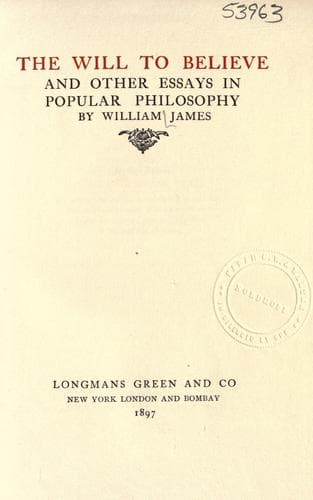
The Will to Believe, and Other Essays in Popular PhilosophyJames, William
Religion
The Will to Believe, and Other Essays in Popular Philosophy
James, William
Belief and doubt; Essays; Philosophy
No! Purely inward forces are certainly at work here. All the higher,
more penetrating ideals are {189} revolutionary. They present
themselves far less in the guise of effects of past experience than in
that of probable causes of future experience, factors to which the
environment and the lessons it has so far taught as must learn to bend.
This is all I can say of the psychological question now. In the last
chapter of a recent work[2] I have sought to prove in a general way the
existence, in our thought, of relations which do not merely repeat the
couplings of experience. Our ideals have certainly many sources. They
are not all explicable as signifying corporeal pleasures to be gained,
and pains to be escaped. And for having so constantly perceived this
psychological fact, we must applaud the intuitionist school. Whether
or not such applause must be extended to that school's other
characteristics will appear as we take up the following questions.
The next one in order is the metaphysical question, of what we mean by
the words 'obligation,' 'good,' and 'ill.'
II.
First of all, it appears that such words can have no application or
relevancy in a world in which no sentient life exists. Imagine an
absolutely material world, containing only physical and chemical facts,
and existing from eternity without a God, without even an interested
spectator: would there be any sense in saying of that world that one of
its states is better than another? Or if there were two such worlds
possible, would there be any rhyme or reason in calling one good and
the other bad,--good or {190} bad positively, I mean, and apart from
the fact that one might relate itself better than the other to the
philosopher's private interests? But we must leave these private
interests out of the account, for the philosopher is a mental fact, and
we are asking whether goods and evils and obligations exist in physical
facts _per se_. Surely there is no _status_ for good and evil to exist
in, in a purely insentient world. How can one physical fact,
considered simply as a physical fact, be 'better' than another?
Betterness is not a physical relation. In its mere material capacity,
a thing can no more be good or bad than it can be pleasant or painful.
Good for what? Good for the production of another physical fact, do
you say? But what in a purely physical universe demands the production
of that other fact? Physical facts simply _are_ or are _not_; and
neither when present or absent, can they be supposed to make demands.
If they do, they can only do so by having desires; and then they have
ceased to be purely physical facts, and have become facts of conscious
sensibility. Goodness, badness, and obligation must be _realised_
somewhere in order really to exist; and the first step in ethical
philosophy is to see that no merely inorganic 'nature of things' can
realize them. Neither moral relations nor the moral law can swing _in
vacuo_.
Public-domain text, read in full here on John Shaqi.
Reviews
Reviews
No reviews yet
Be the first to share your thoughts on this work.
Elsewhere in the archive
Join the Discussion
Join the discussion
Sign in to leave a comment or review.
Sign InorCreate an account