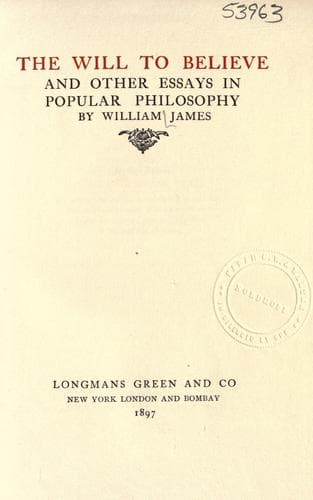
The Will to Believe, and Other Essays in Popular PhilosophyJames, William
Religion
The Will to Believe, and Other Essays in Popular Philosophy
James, William
Belief and doubt; Essays; Philosophy
Since the outcome of the discussion so far has been to show us that
nothing can be good or right except {193} so far as some consciousness
feels it to be good or thinks it to be right, we perceive on the very
threshold that the real superiority and authority which are postulated
by the philosopher to reside in some of the opinions, and the really
inferior character which he supposes must belong to others, cannot be
explained by any abstract moral 'nature of things' existing
antecedently to the concrete thinkers themselves with their ideals.
Like the positive attributes good and bad, the comparative ones better
and worse must be _realised_ in order to be real. If one ideal
judgment be objectively better than another, that betterness must be
made flesh by being lodged concretely in some one's actual perception.
It cannot float in the atmosphere, for it is not a sort of
meteorological phenomenon, like the aurora borealis or the zodiacal
light. Its _esse_ is _percipi_, like the _esse_ of the ideals
themselves between which it obtains. The philosopher, therefore, who
seeks to know which ideal ought to have supreme weight and which one
ought to be subordinated, must trace the _ought_ itself to the _de
facto_ constitution of some existing consciousness, behind which, as
one of the data of the universe, he as a purely ethical philosopher is
unable to go. This consciousness must make the one ideal right by
feeling it to be right, the other wrong by feeling it to be wrong. But
now what particular consciousness in the universe _can_ enjoy this
prerogative of obliging others to conform to a rule which it lays down?
If one of the thinkers were obviously divine, while all the rest were
human, there would probably be no practical dispute about the matter.
The divine thought would be the model, to which the others should
conform. But still the theoretic question {194} would remain, What is
the ground of the obligation, even here?
In our first essays at answering this question, there is an inevitable
tendency to slip into an assumption which ordinary men follow when they
are disputing with one another about questions of good and bad. They
imagine an abstract moral order in which the objective truth resides;
and each tries to prove that this pre-existing order is more accurately
reflected in his own ideas than in those of his adversary. It is
because one disputant is backed by this overarching abstract order that
we think the other should submit. Even so, when it is a question no
longer of two finite thinkers, but of God and ourselves,--we follow our
usual habit, and imagine a sort of _de jure_ relation, which antedates
and overarches the mere facts, and would make it right that we should
conform our thoughts to God's thoughts, even though he made no claim to
that effect, and though we preferred _de facto_ to go on thinking for
ourselves.
Public-domain text, read in full here on John Shaqi.
Reviews
Reviews
No reviews yet
Be the first to share your thoughts on this work.
Elsewhere in the archive
Join the Discussion
Join the discussion
Sign in to leave a comment or review.
Sign InorCreate an account