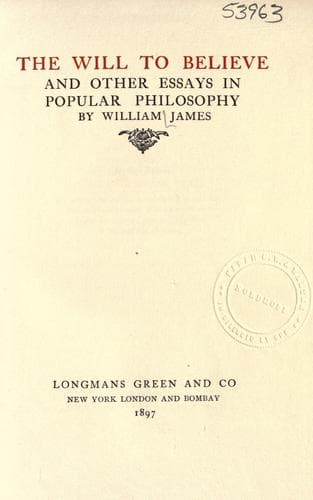
The Will to Believe, and Other Essays in Popular PhilosophyJames, William
Religion
The Will to Believe, and Other Essays in Popular Philosophy
James, William
Belief and doubt; Essays; Philosophy
But the moment we take a steady look at the question, _we see not only
that without a claim actually made by some concrete person there can be
no obligation, but that there is some obligation wherever there is a
claim_. Claim and obligation are, in fact, coextensive terms; they
cover each other exactly. Our ordinary attitude of regarding ourselves
as subject to an overarching system of moral relations, true 'in
themselves,' is therefore either an out-and-out superstition, or else
it must be treated as a merely provisional abstraction from that real
Thinker in whose actual demand upon us to think as he does our
obligation must be ultimately based. In a theistic-ethical philosophy
that thinker in question is, of {195} course, the Deity to whom the
existence of the universe is due.
I know well how hard it is for those who are accustomed to what I have
called the superstitious view, to realize that every _de facto_ claim
creates in so far forth an obligation. We inveterately think that
something which we call the 'validity' of the claim is what gives to it
its obligatory character, and that this validity is something outside
of the claim's mere existence as a matter of fact. It rains down upon
the claim, we think, from some sublime dimension of being, which the
moral law inhabits, much as upon the steel of the compass-needle the
influence of the Pole rains down from out of the starry heavens. But
again, how can such an inorganic abstract character of imperativeness,
additional to the imperativeness which is in the concrete claim itself,
_exist_? Take any demand, however slight, which any creature, however
weak, may make. Ought it not, for its own sole sake, to be satisfied?
If not, prove why not. The only possible kind of proof you could
adduce would be the exhibition of another creature who should make a
demand that ran the other way. The only possible reason there can be
why any phenomenon ought to exist is that such a phenomenon actually is
desired. Any desire is imperative to the extent of its amount; it
_makes_ itself valid by the fact that it exists at all. Some desires,
truly enough, are small desires; they are put forward by insignificant
persons, and we customarily make light of the obligations which they
bring. But the fact that such personal demands as these impose small
obligations does not keep the largest obligations from being personal
demands.
Public-domain text, read in full here on John Shaqi.
Reviews
Reviews
No reviews yet
Be the first to share your thoughts on this work.
Elsewhere in the archive
Join the Discussion
Join the discussion
Sign in to leave a comment or review.
Sign InorCreate an account