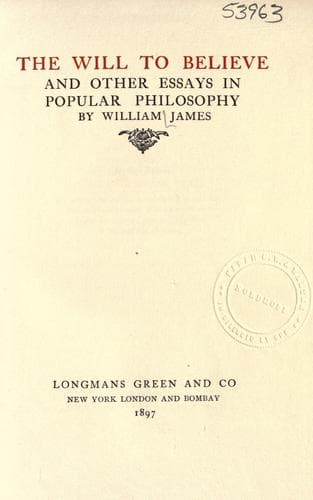
The Will to Believe, and Other Essays in Popular PhilosophyJames, William
Religion
The Will to Believe, and Other Essays in Popular Philosophy
James, William
Belief and doubt; Essays; Philosophy
We stand ourselves at present in the place of that philosopher, and
must not fail to realize all the features that the situation comports.
In the first place we will not be sceptics; we hold to it that there is
a truth to be ascertained. But in the second place we have just gained
the insight that that truth cannot be a self-proclaiming set of laws,
or an abstract 'moral reason,' but can only exist in act, or in the
shape of an opinion held by some thinker really to be found. There is,
however, no visible thinker invested with authority. Shall we then
simply proclaim our own ideals as the lawgiving ones? No; for if we
are true philosophers we must throw our own spontaneous ideals, even
the dearest, impartially in with that total mass of ideals which are
fairly to be judged. But how then can we as philosophers ever find a
test; how avoid complete moral scepticism on the one hand, and on the
other escape bringing a wayward personal standard of our own along with
us, on which we simply pin our faith?
The dilemma is a hard one, nor does it grow a bit more easy as we
revolve it in our minds. The entire undertaking of the philosopher
obliges him to seek an impartial test. That test, however, must be
incarnated in the demand of some actually existent person; and how can
he pick out the person save by an act in which his own sympathies and
prepossessions are implied?
One method indeed presents itself, and has as a matter of history been
taken by the more serious {200} ethical schools. If the heap of things
demanded proved on inspection less chaotic than at first they seemed,
if they furnished their own relative test and measure, then the
casuistic problem would be solved. If it were found that all goods
_quâ_ goods contained a common essence, then the amount of this essence
involved in any one good would show its rank in the scale of goodness,
and order could be quickly made; for this essence would be _the_ good
upon which all thinkers were agreed, the relatively objective and
universal good that the philosopher seeks. Even his own private ideals
would be measured by their share of it, and find their rightful place
among the rest.
Various essences of good have thus been found and proposed as bases of
the ethical system. Thus, to be a mean between two extremes; to be
recognized by a special intuitive faculty; to make the agent happy for
the moment; to make others as well as him happy in the long run; to add
to his perfection or dignity; to harm no one; to follow from reason or
flow from universal law; to be in accordance with the will of God; to
promote the survival of the human species on this planet,--are so many
tests, each of which has been maintained by somebody to constitute the
essence of all good things or actions so far as they are good.
Public-domain text, read in full here on John Shaqi.
Reviews
Reviews
No reviews yet
Be the first to share your thoughts on this work.
Elsewhere in the archive
Join the Discussion
Join the discussion
Sign in to leave a comment or review.
Sign InorCreate an account