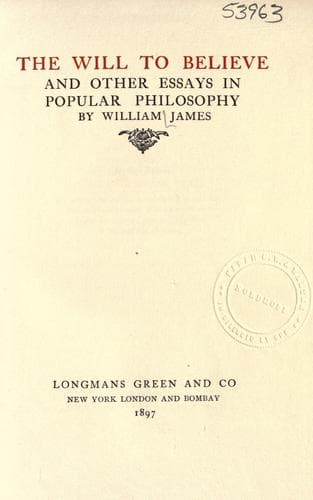
The Will to Believe, and Other Essays in Popular PhilosophyJames, William
Religion
The Will to Believe, and Other Essays in Popular Philosophy
James, William
Belief and doubt; Essays; Philosophy
Wherever such minds exist, with judgments of good and ill, and demands
upon one another, there is an ethical world in its essential features.
Were all other things, gods and men and starry heavens, blotted out
from this universe, and were there left but one rock with two loving
souls upon it, that rock would have as thoroughly moral a constitution
as any possible world which the eternities and immensities could
harbor. It would be a tragic constitution, because the rock's
inhabitants would die. But while they lived, there would be real good
things and real bad things in the universe; there would be obligations,
claims, and expectations; obediences, refusals, and disappointments;
compunctions and longings for harmony to come again, and inward peace
of conscience when it was restored; there would, in short, be a moral
life, whose active energy would have no limit but the intensity of
interest in each other with which the hero and heroine might be endowed.
{198}
We, on this terrestrial globe, so far as the visible facts go, are just
like the inhabitants of such a rock. Whether a God exist, or whether
no God exist, in yon blue heaven above us bent, we form at any rate an
ethical republic here below. And the first reflection which this leads
to is that ethics have as genuine and real a foothold in a universe
where the highest consciousness is human, as in a universe where there
is a God as well. 'The religion of humanity' affords a basis for
ethics as well as theism does. Whether the purely human system can
gratify the philosopher's demand as well as the other is a different
question, which we ourselves must answer ere we close.
III.
The last fundamental question in Ethics was, it will be remembered, the
_casuistic_ question. Here we are, in a world where the existence of a
divine thinker has been and perhaps always will be doubted by some of
the lookers-on, and where, in spite of the presence of a large number
of ideals in which human beings agree, there are a mass of others about
which no general consensus obtains. It is hardly necessary to present
a literary picture of this, for the facts are too well known. The wars
of the flesh and the spirit in each man, the concupiscences of
different individuals pursuing the same unshareable material or social
prizes, the ideals which contrast so according to races, circumstances,
temperaments, philosophical beliefs, etc.,--all form a maze of
apparently inextricable confusion with no obvious Ariadne's thread to
lead one out. Yet the philosopher, just because he is a philosopher,
adds his own peculiar ideal to the confusion {199} (with which if he
were willing to be a sceptic he would be passably content), and insists
that over all these individual opinions there is a _system of truth_
which he can discover if he only takes sufficient pains.
Public-domain text, read in full here on John Shaqi.
Reviews
Reviews
No reviews yet
Be the first to share your thoughts on this work.
Elsewhere in the archive
Join the Discussion
Join the discussion
Sign in to leave a comment or review.
Sign InorCreate an account