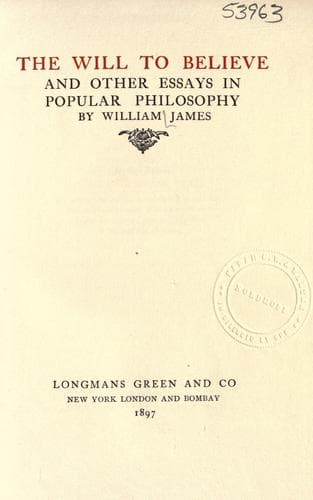
The Will to Believe, and Other Essays in Popular PhilosophyJames, William
Religion
The Will to Believe, and Other Essays in Popular Philosophy
James, William
Belief and doubt; Essays; Philosophy
A look at another peculiarity of the ethical universe, as we find it,
will still further show us the philosopher's perplexities. As a purely
theoretic problem, namely, the casuistic question would hardly ever
come up at all. If the ethical philosopher were only asking after the
best _imaginable_ system of goods he would indeed have an easy task;
for all demands as {202} such are _primâ facie_ respectable, and the
best simply imaginary world would be one in which _every_ demand was
gratified as soon as made. Such a world would, however, have to have a
physical constitution entirely different from that of the one which we
inhabit. It would need not only a space, but a time, 'of
_n_-dimensions,' to include all the acts and experiences incompatible
with one another here below, which would then go on in
conjunction,--such as spending our money, yet growing rich; taking our
holiday, yet getting ahead with our work; shooting and fishing, yet
doing no hurt to the beasts; gaining no end of experience, yet keeping
our youthful freshness of heart; and the like. There can be no
question that such a system of things, however brought about, would be
the absolutely ideal system; and that if a philosopher could create
universes _à priori_, and provide all the mechanical conditions, that
is the sort of universe which he should unhesitatingly create.
But this world of ours is made on an entirely different pattern, and
the casuistic question here is most tragically practical. The actually
possible in this world is vastly narrower than all that is demanded;
and there is always a _pinch_ between the ideal and the actual which
can only be got through by leaving part of the ideal behind. There is
hardly a good which we can imagine except as competing for the
possession of the same bit of space and time with some other imagined
good. Every end of desire that presents itself appears exclusive of
some other end of desire. Shall a man drink and smoke, _or_ keep his
nerves in condition?--he cannot do both. Shall he follow his fancy for
Amelia, _or_ for Henrietta?--both cannot be the choice of his heart.
Shall he have the {203} dear old Republican party, _or_ a spirit of
unsophistication in public affairs?--he cannot have both, etc. So that
the ethical philosopher's demand for the right scale of subordination
in ideals is the fruit of an altogether practical need. Some part of
the ideal must be butchered, and he needs to know which part. It is a
tragic situation, and no mere speculative conundrum, with which he has
to deal.
Public-domain text, read in full here on John Shaqi.
Reviews
Reviews
No reviews yet
Be the first to share your thoughts on this work.
Elsewhere in the archive
Join the Discussion
Join the discussion
Sign in to leave a comment or review.
Sign InorCreate an account