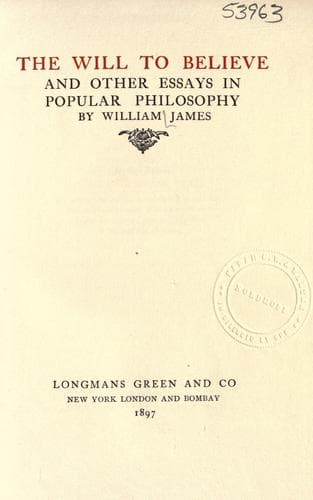
The Will to Believe, and Other Essays in Popular PhilosophyJames, William
Religion
The Will to Believe, and Other Essays in Popular Philosophy
James, William
Belief and doubt; Essays; Philosophy
Now we are blinded to the real difficulty of the philosopher's task by
the fact that we are born into a society whose ideals are largely
ordered already. If we follow the ideal which is conventionally
highest, the others which we butcher either die and do not return to
haunt us; or if they come back and accuse us of murder, every one
applauds us for turning to them a deaf ear. In other words, our
environment encourages us not to be philosophers but partisans. The
philosopher, however, cannot, so long as he clings to his own ideal of
objectivity, rule out any ideal from being heard. He is confident, and
rightly confident, that the simple taking counsel of his own intuitive
preferences would be certain to end in a mutilation of the fulness of
the truth. The poet Heine is said to have written 'Bunsen' in the
place of 'Gott' in his copy of that author's work entitled "God in
History," so as to make it read 'Bunsen in der Geschichte.' Now, with
no disrespect to the good and learned Baron, is it not safe to say that
any single philosopher, however wide his sympathies, must be just such
a Bunsen in der Geschichte of the moral world, so soon as he attempts
to put his own ideas of order into that howling mob of desires, each
struggling to get breathing-room for the ideal to which it clings? The
very best of men must not only be insensible, but {204} be ludicrously
and peculiarly insensible, to many goods. As a militant, fighting
free-handed that the goods to which he is sensible may not be submerged
and lost from out of life, the philosopher, like every other human
being, is in a natural position. But think of Zeno and of Epicurus,
think of Calvin and of Paley, think of Kant and Schopenhauer, of
Herbert Spencer and John Henry Newman, no longer as one-sided champions
of special ideals, but as schoolmasters deciding what all must
think,--and what more grotesque topic could a satirist wish for on
which to exercise his pen? The fabled attempt of Mrs. Partington to
arrest the rising tide of the North Atlantic with her broom was a
reasonable spectacle compared with their effort to substitute the
content of their clean-shaven systems for that exuberant mass of goods
with which all human nature is in travail, and groaning to bring to the
light of day. Think, furthermore, of such individual moralists, no
longer as mere schoolmasters, but as pontiffs armed with the temporal
power, and having authority in every concrete case of conflict to order
which good shall be butchered and which shall be suffered to
survive,--and the notion really turns one pale. All one's slumbering
revolutionary instincts waken at the thought of any single moralist
wielding such powers of life and death. Better chaos forever than an
order based on any closet-philosopher's rule, even though he were the
most enlightened possible member of his tribe. No! if the philosopher
is to keep his judicial position, he must never become one of the
parties to the fray.
Public-domain text, read in full here on John Shaqi.
Reviews
Reviews
No reviews yet
Be the first to share your thoughts on this work.
Elsewhere in the archive
Join the Discussion
Join the discussion
Sign in to leave a comment or review.
Sign InorCreate an account