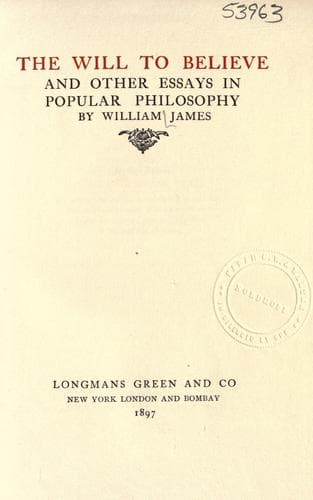
The Will to Believe, and Other Essays in Popular PhilosophyJames, William
Religion
The Will to Believe, and Other Essays in Popular Philosophy
James, William
Belief and doubt; Essays; Philosophy
The deepest difference, practically, in the moral life of man is the
difference between the easy-going and the strenuous mood. When in the
easy-going mood the shrinking from present ill is our ruling
consideration. The strenuous mood, on the contrary, makes us quite
indifferent to present ill, if only the greater ideal be attained. The
capacity for the strenuous mood probably lies slumbering in every man,
but it has more difficulty in some than in others in waking up. It
needs the wilder passions to arouse it, the big fears, loves, and
indignations; or else the deeply penetrating appeal of some one of the
higher fidelities, like justice, truth, or freedom. Strong relief is a
necessity of its vision; and a world where all the mountains are
brought down and all the valleys are {212} exalted is no congenial
place for its habitation. This is why in a solitary thinker this mood
might slumber on forever without waking. His various ideals, known to
him to be mere preferences of his own, are too nearly of the same
denominational value: he can play fast or loose with them at will.
This too is why, in a merely human world without a God, the appeal to
our moral energy falls short of its maximal stimulating power. Life,
to be sure, is even in such a world a genuinely ethical symphony; but
it is played in the compass of a couple of poor octaves, and the
infinite scale of values fails to open up. Many of us, indeed,--like
Sir James Stephen in those eloquent 'Essays by a Barrister,'--would
openly laugh at the very idea of the strenuous mood being awakened in
us by those claims of remote posterity which constitute the last appeal
of the religion of humanity. We do not love these men of the future
keenly enough; and we love them perhaps the less the more we hear of
their evolutionized perfection, their high average longevity and
education, their freedom from war and crime, their relative immunity
from pain and zymotic disease, and all their other negative
superiorities. This is all too finite, we say; we see too well the
vacuum beyond. It lacks the note of infinitude and mystery, and may
all be dealt with in the don't-care mood. No need of agonizing
ourselves or making others agonize for these good creatures just at
present.
Public-domain text, read in full here on John Shaqi.
Reviews
Reviews
No reviews yet
Be the first to share your thoughts on this work.
Elsewhere in the archive
Join the Discussion
Join the discussion
Sign in to leave a comment or review.
Sign InorCreate an account