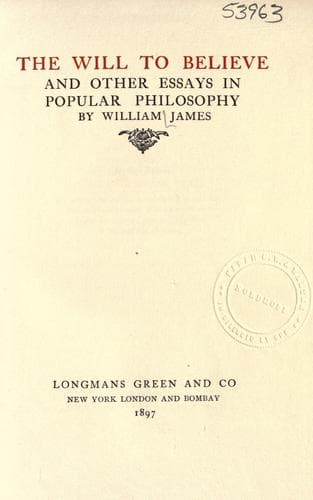
The Will to Believe, and Other Essays in Popular PhilosophyJames, William
Religion
The Will to Believe, and Other Essays in Popular Philosophy
James, William
Belief and doubt; Essays; Philosophy
The philosopher, then, _quâ_ philosopher, is no better able to
determine the best universe in the concrete emergency than other men.
He sees, indeed, somewhat better than most men, what the question
always is,--not a question of this good or that good simply taken, but
of the two total {210} universes with which these goods respectively
belong. He knows that he must vote always for the richer universe, for
the good which seems most organizable, most fit to enter into complex
combinations, most apt to be a member of a more inclusive whole. But
which particular universe this is he cannot know for certain in
advance; he only knows that if he makes a bad mistake the cries of the
wounded will soon inform him of the fact. In all this the philosopher
is just like the rest of us non-philosophers, so far as we are just and
sympathetic instinctively, and so far as we are open to the voice of
complaint. His function is in fact indistinguishable from that of the
best kind of statesman at the present day. His books upon ethics,
therefore, so far as they truly touch the moral life, must more and
more ally themselves with a literature which is confessedly tentative
and suggestive rather than dogmatic,--I mean with novels and dramas of
the deeper sort, with sermons, with books on statecraft and
philanthropy and social and economical reform. Treated in this way
ethical treatises may be voluminous and luminous as well; but they
never can be _final_, except in their abstractest and vaguest features;
and they must more and more abandon the old-fashioned, clear-cut, and
would-be 'scientific' form.
V.
The chief of all the reasons why concrete ethics cannot be final is
that they have to wait on metaphysical and theological beliefs. I said
some time back that real ethical relations existed in a purely human
world. They would exist even in what we called a moral solitude if the
thinker had various {211} ideals which took hold of him in turn. His
self of one day would make demands on his self of another; and some of
the demands might be urgent and tyrannical, while others were gentle
and easily put aside. We call the tyrannical demands _imperatives_.
If we ignore these we do not hear the last of it. The good which we
have wounded returns to plague us with interminable crops of
consequential damages, compunctions, and regrets. Obligation can thus
exist inside a single thinker's consciousness; and perfect peace can
abide with him only so far as he lives according to some sort of a
casuistic scale which keeps his more imperative goods on top. It is
the nature of these goods to be cruel to their rivals. Nothing shall
avail when weighed in the balance against them. They call out all the
mercilessness in our disposition, and do not easily forgive us if we
are so soft-hearted as to shrink from sacrifice in their behalf.
Public-domain text, read in full here on John Shaqi.
Reviews
Reviews
No reviews yet
Be the first to share your thoughts on this work.
Elsewhere in the archive
Join the Discussion
Join the discussion
Sign in to leave a comment or review.
Sign InorCreate an account