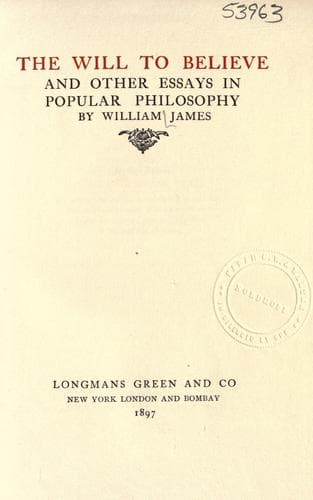
The Will to Believe, and Other Essays in Popular PhilosophyJames, William
Religion
The Will to Believe, and Other Essays in Popular Philosophy
James, William
Belief and doubt; Essays; Philosophy
Scholastic orthodoxy, to which one must always go when one wishes to
find perfectly clear statement, has beautifully elaborated this
absolutist conviction in a doctrine which it calls that of 'objective
evidence.' If, for example, I am unable to doubt that I now exist
before you, that two is less than three, or that if all men are mortal
then I am mortal too, it is because these things illumine my intellect
irresistibly. The final ground of this objective evidence possessed by
certain propositions is the _adaequatio intellectûs nostri cum rê_.
The certitude it brings involves an _aptitudinem ad extorquendum certum
assensum_ on the part of the truth envisaged, and on the side of the
subject a _quietem in cognitione_, when once the object is mentally
received, that leaves no possibility of doubt behind; and in the whole
transaction nothing operates but the _entitas ipsa_ of the object and
the _entitas ipsa_ of the mind. We slouchy modern thinkers dislike to
talk in Latin,--indeed, we dislike to talk in set terms at all; but at
bottom our own state of mind is very much like this whenever we
uncritically abandon ourselves: You believe in objective evidence, and
I do. Of some things we feel that we are certain: we know, and we know
that we do know. There is something that gives a click inside of us, a
bell that strikes twelve, when the hands of our mental clock have swept
the dial and meet over the meridian hour. The greatest empiricists
among us are only empiricists on reflection: when {14} left to their
instincts, they dogmatize like infallible popes. When the Cliffords
tell us how sinful it is to be Christians on such 'insufficient
evidence,' insufficiency is really the last thing they have in mind.
For them the evidence is absolutely sufficient, only it makes the other
way. They believe so completely in an anti-christian order of the
universe that there is no living option: Christianity is a dead
hypothesis from the start.
VI.
But now, since we are all such absolutists by instinct, what in our
quality of students of philosophy ought we to do about the fact? Shall
we espouse and indorse it? Or shall we treat it as a weakness of our
nature from which we must free ourselves, if we can?
Public-domain text, read in full here on John Shaqi.
Reviews
Reviews
No reviews yet
Be the first to share your thoughts on this work.
Join the Discussion
Join the discussion
Sign in to leave a comment or review.
Sign InorCreate an account