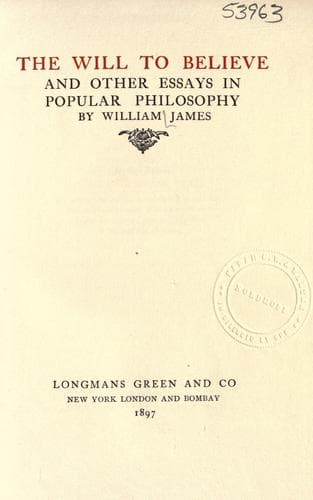
The Will to Believe, and Other Essays in Popular PhilosophyJames, William
Religion
The Will to Believe, and Other Essays in Popular Philosophy
James, William
Belief and doubt; Essays; Philosophy
Darwin's first achievement was to show the utter insignificance in
amount of these changes produced by direct adaptation, the immensely
greater mass of changes being produced by internal molecular accidents,
of which we know nothing. His next achievement was to define the true
problem with which we have to deal when we study the effects of the
visible environment on the animal. That problem is simply this; Is the
environment more likely to _preserve or to destroy him_, on account of
this or that peculiarity with which he may be born? In giving the name
of 'accidental variations' to those peculiarities with which an animal
is born, Darwin does not for a moment mean to suggest that they are not
the fixed outcome of natural law. If the total system of the universe
be taken into account, the causes of these variations and the visible
environment which preserves or destroys them, undoubtedly do, in some
remote and roundabout way, hang together. What Darwin means is, that,
since that environment is a perfectly known thing, and its relations to
the organism in the way of destruction or preservation are tangible and
distinct, it would utterly confuse our finite understandings and
frustrate our hopes of science to mix in with it facts from such a
disparate and incommensurable cycle as that in which the variations are
produced. This last cycle is that of occurrences before the animal is
born. It is the cycle of influences upon ova and embryos; {224} in
which lie the causes that tip them and tilt them towards masculinity or
femininity, towards strength or weakness, towards health or disease,
and towards divergence from the parent type. What are the causes there?
In the first place, they are molecular and invisible,--inaccessible,
therefore, to direct observation of any kind. Secondly, their
operations are compatible with any social, political, and physical
conditions of environment. The same parents, living in the same
environing conditions, may at one birth produce a genius, at the next
an idiot or a monster. The visible external conditions are therefore
not direct determinants of this cycle; and the more we consider the
matter, the more we are forced to believe that two children of the same
parents are made to differ from each other by causes as
disproportionate to their ultimate effects as is the famous pebble on
the Rocky Mountain crest, which separates two rain-drops, to the Gulf
of St. Lawrence and the Pacific Ocean toward which it makes them
severally flow.
Public-domain text, read in full here on John Shaqi.
Reviews
Reviews
No reviews yet
Be the first to share your thoughts on this work.
Elsewhere in the archive
Join the Discussion
Join the discussion
Sign in to leave a comment or review.
Sign InorCreate an account