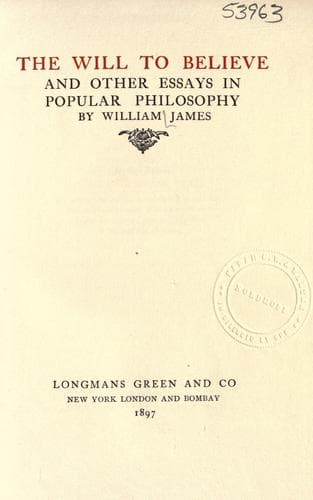
The Will to Believe, and Other Essays in Popular PhilosophyJames, William
Religion
The Will to Believe, and Other Essays in Popular Philosophy
James, William
Belief and doubt; Essays; Philosophy
The great mechanical distinction between transitive forces and
discharging forces is nowhere illustrated on such a scale as in
physiology. Almost all causes there are forces of _detent_, which
operate by simply unlocking energy already stored up. They are
upsetters of unstable equilibria, and the resultant effect depends
infinitely more on the nature of the materials upset than on that of
the particular stimulus which joggles them down. Galvanic work, equal
to unity, done on a frog's nerve will discharge from the muscle to
which the nerve belongs mechanical work equal to seventy thousand; and
exactly the same muscular {225} effect will emerge if other irritants
than galvanism are employed. The irritant has merely started or
provoked something which then went on of itself,--as a match may start
a fire which consumes a whole town. And qualitatively as well as
quantitatively the effect may be absolutely incommensurable with the
cause. We find this condition of things in ail organic matter.
Chemists are distracted by the difficulties which the instability of
albuminoid compounds opposes to their study. Two specimens, treated in
what outwardly seem scrupulously identical conditions, behave in quite
different ways. You know about the invisible factors of fermentation,
and how the fate of a jar of milk--whether it turn into a sour clot or
a mass of koumiss--depends on whether the lactic acid ferment or the
alcoholic is introduced first, and gets ahead of the other in starting
the process. Now, when the result is the tendency of an ovum, itself
invisible to the naked eye, to tip towards this direction or that in
its further evolution,--to bring forth a genius or a dunce, even as the
rain-drop passes east or west of the pebble,--is it not obvious that
the deflecting cause must lie in a region so recondite and minute, must
be such a ferment of a ferment, an infinitesimal of so high an order,
that surmise itself may never succeed even in attempting to frame an
image of it?
Such being the case, was not Darwin right to turn his back upon that
region altogether, and to keep his own problem carefully free from all
entanglement with matters such as these? The success of his work is a
sufficiently affirmative reply.
Public-domain text, read in full here on John Shaqi.
Reviews
Reviews
No reviews yet
Be the first to share your thoughts on this work.
Elsewhere in the archive
Join the Discussion
Join the discussion
Sign in to leave a comment or review.
Sign InorCreate an account