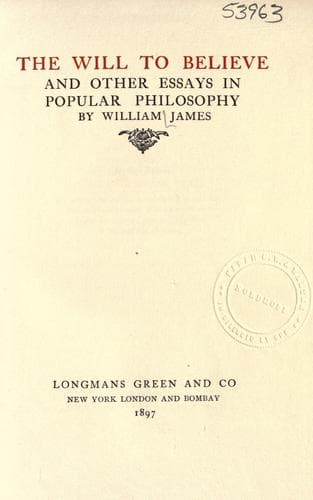
The Will to Believe, and Other Essays in Popular PhilosophyJames, William
Religion
The Will to Believe, and Other Essays in Popular Philosophy
James, William
Belief and doubt; Essays; Philosophy
And this brings us at last to the heart of our subject. The causes of
production of great men lie in a {226} sphere wholly inaccessible to
the social philosopher. He must simply accept geniuses as data, just
as Darwin accepts his spontaneous variations. For him, as for Darwin,
the only problem is, these data being given, How does the environment
affect them, and how do they affect the environment? Now, I affirm
that the relation of the visible environment to the great man is in the
main exactly what it is to the 'variation' in the Darwinian philosophy.
It chiefly adopts or rejects, preserves or destroys, in short _selects_
him.[3] And whenever it adopts and preserves the great man, it becomes
modified by his influence in an entirely original and peculiar way. He
acts as a ferment, and changes its constitution, just as the advent of
a new zoölogical species changes the faunal and floral equilibrium of
the region in which it appears. We all recollect Mr. Darwin's famous
statement of the influence of cats on the growth of clover in their
neighborhood. We all have read of the effects of the European rabbit
in New Zealand, and we have many of us taken part in the controversy
about the English sparrow here,--whether he kills most canker-worms, or
drives away most native birds. Just so the great man, whether he be an
importation from without like Clive in India or Agassiz here, or
whether he spring from the soil like Mahomet or Franklin, brings about
a rearrangement, on a large or a small scale, of the pre-existing
social relations.
{227}
The mutations of societies, then, from generation to generation, are in
the main due directly or indirectly to the acts or the example of
individuals whose genius was so adapted to the receptivities of the
moment, or whose accidental position of authority was so critical that
they became ferments, initiators of movement, setters of precedent or
fashion, centres of corruption, or destroyers of other persons, whose
gifts, had they had free play, would have led society in another
direction.
Public-domain text, read in full here on John Shaqi.
Reviews
Reviews
No reviews yet
Be the first to share your thoughts on this work.
Elsewhere in the archive
Join the Discussion
Join the discussion
Sign in to leave a comment or review.
Sign InorCreate an account