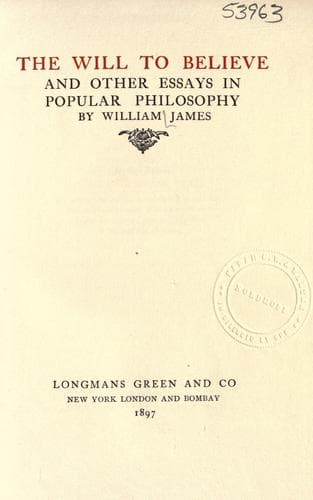
The Will to Believe, and Other Essays in Popular PhilosophyJames, William
Religion
The Will to Believe, and Other Essays in Popular Philosophy
James, William
Belief and doubt; Essays; Philosophy
Would England have to-day the 'imperial' ideal which she now has, if a
certain boy named Bob Clive had shot himself, as he tried to do, at
Madras? Would she be the drifting raft she is now in European
affairs[4] if a Frederic the Great had inherited her throne instead of
a Victoria, and if Messrs. Bentham, Mill, Cobden, and Bright had all
been born in Prussia? England has, no doubt, to-day precisely the same
intrinsic value relatively to the other nations that she ever had.
There is no such fine accumulation of human material upon the globe.
But in England the material has lost effective form, while in Germany
it has found it. Leaders give the form. Would England be crying
forward and backward at once, as she does now, 'letting I will not wait
upon I would,' wishing to conquer but not to fight, if her ideal had in
all these years been fixed by a succession of statesmen of supremely
commanding personality, working in one direction? Certainly not. She
would have espoused, for better or worse, either one course or another.
Had Bismarck died in his cradle, the Germans would still be satisfied
with appearing to themselves as a race of spectacled _Gelehrten_ and
political herbivora, and to the French as _ces bons_, or _ces naifs_,
{229} _Allemands_. Bismarck's will showed them, to their own great
astonishment, that they could play a far livelier game. The lesson
will not be forgotten. Germany may have many vicissitudes, but they--
"will never do away, I ween,
The marks of that which once hath been"--
of Bismarck's initiative, namely, from 1860 to 1873.
The fermentative influence of geniuses must be admitted as, at any
rate, one factor in the changes that constitute social evolution. The
community _may_ evolve in many ways. The accidental presence of this
or that ferment decides in which way it _shall_ evolve. Why, the very
birds of the forest, the parrot, the mino, have the power of human
speech, but never develop it of themselves; some one must be there to
teach them. So with us individuals. Rembrandt must teach us to enjoy
the struggle of light with darkness, Wagner to enjoy peculiar musical
effects; Dickens gives a twist to our sentimentality, Artemus Ward to
our humor; Emerson kindles a new moral light within us. But it is like
Columbus's egg. "All can raise the flowers now, for all have got the
seed." But if this be true of the individuals in the community, how
can it be false of the community as a whole? If shown a certain way, a
community may take it; if not, it will never find it. And the ways are
to a large extent indeterminate in advance. A nation may obey either
of many alternative impulses given by different men of genius, and
still live and be prosperous, just as a man may enter either of many
businesses. Only, the prosperities may differ in their type.
Public-domain text, read in full here on John Shaqi.
Reviews
Reviews
No reviews yet
Be the first to share your thoughts on this work.
Elsewhere in the archive
Join the Discussion
Join the discussion
Sign in to leave a comment or review.
Sign InorCreate an account