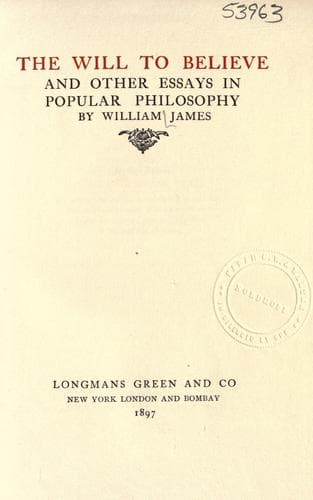
The Will to Believe, and Other Essays in Popular PhilosophyJames, William
Religion
The Will to Believe, and Other Essays in Popular Philosophy
James, William
Belief and doubt; Essays; Philosophy
But the indeterminism is not absolute. Not every {230} 'man' fits
every 'hour.' Some incompatibilities there are. A given genius may
come either too early or too late. Peter the Hermit would now be sent
to a lunatic asylum. John Mill in the tenth century would have lived
and died unknown. Cromwell and Napoleon need their revolutions, Grant
his civil war. An Ajax gets no fame in the day of telescopic-sighted
rifles; and, to express differently an instance which Spencer uses,
what could a Watt have effected in a tribe which no precursive genius
had taught to smelt iron or to turn a lathe?
Now, the important thing to notice is that what makes a certain genius
now incompatible with his surroundings is usually the fact that some
previous genius of a different strain has warped the community away
from the sphere of his possible effectiveness. After Voltaire, no
Peter the Hermit; after Charles IX. and Louis XIV., no general
protestantization of France; after a Manchester school, a
Beaconsfield's success is transient; after a Philip II., a Castelar
makes little headway; and so on. Each bifurcation cuts off certain
sides of the field altogether, and limits the future possible angles of
deflection. A community is a living thing, and in words which I can do
no better than quote from Professor Clifford,[5] "it is the peculiarity
of living things not merely that they change under the influence of
surrounding circumstances, but that any change which takes place in
them is not lost but retained, and as it were built into the organism
to serve as the foundation for future actions. If you cause any
distortion in the growth of a tree and make it crooked, whatever you
may do afterwards to make the tree straight the mark of your {231}
distortion is there; it is absolutely indelible; it has become part of
the tree's nature.... Suppose, however, that you take a lump of gold,
melt it, and let it cool.... No one can tell by examining a piece of
gold how often it has been melted and cooled in geologic ages, or even
in the last year by the hand of man. Any one who cuts down an oak can
tell by the rings in its trunk how many times winter has frozen it into
widowhood, and how many times summer has warmed it into life. A living
being must always contain within itself the history, not merely of its
own existence, but of all its ancestors."
Public-domain text, read in full here on John Shaqi.
Reviews
Reviews
No reviews yet
Be the first to share your thoughts on this work.
Elsewhere in the archive
Join the Discussion
Join the discussion
Sign in to leave a comment or review.
Sign InorCreate an account