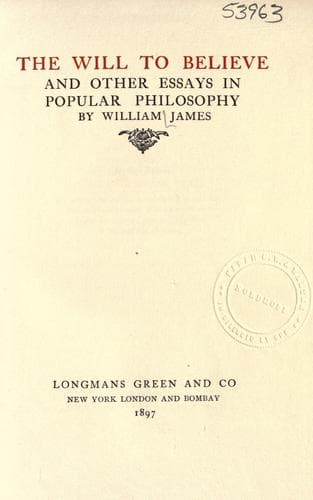
The Will to Believe, and Other Essays in Popular PhilosophyJames, William
Religion
The Will to Believe, and Other Essays in Popular Philosophy
James, William
Belief and doubt; Essays; Philosophy
If by 'physical conditions' Mr. Allen means what he does mean, the
outward cycle of visible nature and man, his assertion is simply
physiologically false. For a national mind differentiates 'itself'
whenever a genius is born in its midst by causes acting in the
invisible and molecular cycle. But if Mr. Allen means by 'physical
conditions' the whole of nature, his assertion, though true, forms but
the vague Asiatic {238} profession of belief in an all-enveloping fate,
which certainly need not plume itself on any specially advanced or
scientific character.
And how can a thinker so clever as Mr. Allen fail to have distinguished
in these matters between _necessary_ conditions and _sufficient_
conditions of a given result? The French say that to have an omelet we
must break our eggs; that is, the breaking of eggs is a necessary
condition of the omelet. But is it a sufficient condition? Does an
omelet appear whenever three eggs are broken? So of the Greek mind.
To get such versatile intelligence it may be that such commercial
dealings with the world as the geographical Hellas afforded are a
necessary condition. But if they are a sufficient condition, why did
not the Phoenicians outstrip the Greeks in intelligence? No
geographical environment can produce a given type of mind. It can only
foster and further certain types fortuitously produced, and thwart and
frustrate others. Once again, its function is simply selective, and
determines what shall actually be only by destroying what is positively
incompatible. An Arctic environment is incompatible with improvident
habits in its denizens; but whether the inhabitants of such a region
shall unite with their thrift the peacefulness of the Eskimo or the
pugnacity of the Norseman is, so far as the climate is concerned, an
accident. Evolutionists should not forget that we all have five
fingers not because four or six would not do just as well, but merely
because the first vertebrate above the fishes _happened_ to have that
number. He owed his prodigious success in founding a line of descent
to some entirely other quality,--we know {239} not which,--but the
inessential five fingers were taken in tow and preserved to the present
day. So of most social peculiarities. Which of them shall be taken in
tow by the few qualities which the environment necessarily exacts is a
matter of what physiological accidents shall happen among individuals.
Mr. Allen promises to prove his thesis in detail by the examples of
China, India, England, Rome, etc. I have not the smallest hesitation
in predicting that he will do no more with these examples than he has
done with Hellas. He will appear upon the scene after the fact, and
show that the quality developed by each race was, naturally enough, not
incompatible with its habitat. But he will utterly fail to show that
the particular form of compatibility fallen into in each case was the
one necessary and only possible form.
Public-domain text, read in full here on John Shaqi.
Reviews
Reviews
No reviews yet
Be the first to share your thoughts on this work.
Elsewhere in the archive
Join the Discussion
Join the discussion
Sign in to leave a comment or review.
Sign InorCreate an account