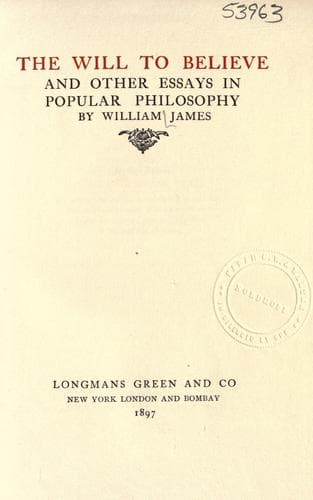
The Will to Believe, and Other Essays in Popular PhilosophyJames, William
Religion
The Will to Believe, and Other Essays in Popular Philosophy
James, William
Belief and doubt; Essays; Philosophy
"The differences between one nation and another, whether in intellect,
commerce, art, morals, or general temperament, ultimately depend, not
upon any mysterious properties of race, nationality, or any other
unknown and unintelligible abstractions, but simply and solely upon the
{236} physical circumstances to which they are exposed. If it be a
fact, as we know it to be, that the French nation differs recognizably
from the Chinese, and the people of Hamburg differ recognizably from
the people of Timbuctoo, then the notorious and conspicuous differences
between them are wholly due to the geographical position of the various
races. If the people who went to Hamburg had gone to Timbuctoo, they
would now be indistinguishable from the semi-barbarian negroes who
inhabit that central African metropolis;[8] and if the people who went
to Timbuctoo had gone to Hamburg, they would now have been
white-skinned merchants driving a roaring trade in imitation sherry and
indigestible port.... The differentiating agency must be sought in the
great permanent geographical features of land and sea; ... these have
necessarily and inevitably moulded the characters and histories of
every nation upon the earth.... We cannot regard any nation as an
active agent in differentiating itself. Only the surrounding
circumstances can have any effect in such a direction. [These two
sentences dogmatically deny the existence of the relatively independent
physiological cycle of causation.] To suppose otherwise is to suppose
that the mind of man is exempt from the universal law of causation.
There is no caprice, no spontaneous impulse, in human endeavors. Even
tastes and inclinations _must_ themselves be the result of surrounding
causes."[9]
{237}
Elsewhere Mr. Allen, writing of the Greek culture, says:--
"It was absolutely and unreservedly the product of the geographical
Hellas, acting upon the given factor of the undifferentiated Aryan
brain,... To me it seems a self-evident proposition that nothing
whatsoever can differentiate one body of men from another, except the
physical conditions in which they are set,--including, of course, under
the term _physical conditions_ the relations of place and time in which
they stand with regard to other bodies of men. To suppose otherwise is
to deny the primordial law of causation. To imagine that the mind can
differentiate itself is to imagine that it can be differentiated
without a cause."[10]
This outcry about the law of universal causation being undone, the
moment we refuse to invest in the kind of causation which is peddled
round by a particular school, makes one impatient. These writers have
no imagination of alternatives. With them there is no _tertium quid_
between outward environment and miracle. _Aut Caesar, aut nullus_!
_Aut_ Spencerism, _aut_ catechism!
Public-domain text, read in full here on John Shaqi.
Reviews
Reviews
No reviews yet
Be the first to share your thoughts on this work.
Elsewhere in the archive
Join the Discussion
Join the discussion
Sign in to leave a comment or review.
Sign InorCreate an account