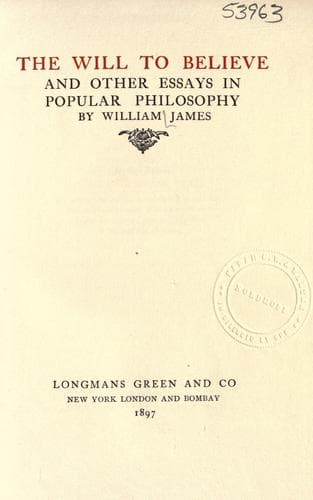
The Will to Believe, and Other Essays in Popular PhilosophyJames, William
Religion
The Will to Believe, and Other Essays in Popular Philosophy
James, William
Belief and doubt; Essays; Philosophy
Sporadic great men come everywhere. But for a community to get
vibrating through and through {243} with intensely active life, many
geniuses coming together and in rapid succession are required. This is
why great epochs are so rare,--why the sudden bloom of a Greece, an
early Rome, a Renaissance, is such a mystery. Blow must follow blow so
fast that no cooling can occur in the intervals. Then the mass of the
nation grows incandescent, and may continue to glow by pure inertia
long after the originators of its internal movement have passed away.
We often hear surprise expressed that in these high tides of human
affairs not only the people should be filled with stronger life, but
that individual geniuses should seem so exceptionally abundant. This
mystery is just about as deep as the time-honored conundrum as to why
great rivers flow by great towns. It is true that great public
fermentations awaken and adopt many geniuses, who in more torpid times
would have had no chance to work. But over and above this there must
be an exceptional concourse of genius about a time, to make the
fermentation begin at all. The unlikeliness of the concourse is far
greater than the unlikeliness of any particular genius; hence the
rarity of these periods and the exceptional aspect which they always
wear.
{244}
It is folly, then, to speak of the 'laws of history' as of something
inevitable, which science has only to discover, and whose consequences
any one can then foretell but do nothing to alter or avert. Why, the
very laws of physics are conditional, and deal with _ifs_. The
physicist does not say, "The water will boil anyhow;" he only says it
will boil if a fire be kindled beneath it. And so the utmost the
student of sociology can ever predict is that _if_ a genius of a
certain sort show the way, society will be sure to follow. It might
long ago have been predicted with great confidence that both Italy and
Germany would reach a stable unity if some one could but succeed in
starting the process. It could not have been predicted, however, that
the _modus operandi_ in each case would be subordination to a paramount
state rather than federation, because no historian could have
calculated the freaks of birth and fortune which gave at the same
moment such positions of authority to three such peculiar individuals
as Napoleon III., Bismarck, and Cavour. So of our own politics. It is
certain now that the movement of the independents, reformers, or
whatever one please to call them, will triumph. But whether it do so
by converting the Republican party to its ends, or by rearing a new
party on the ruins of both our present factions, the historian cannot
say. There can be no doubt that the reform movement would make more
progress in one year with an adequate personal leader than as now in
ten without one. Were there a great citizen, splendid with every civic
gift, to be its candidate, who can doubt that he would lead us to
Public-domain text, read in full here on John Shaqi.
Reviews
Reviews
No reviews yet
Be the first to share your thoughts on this work.
Elsewhere in the archive
Join the Discussion
Join the discussion
Sign in to leave a comment or review.
Sign InorCreate an account