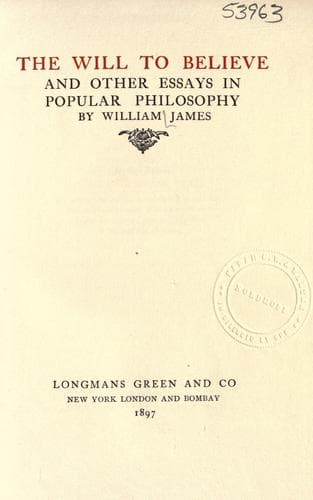
The Will to Believe, and Other Essays in Popular PhilosophyJames, William
Religion
The Will to Believe, and Other Essays in Popular Philosophy
James, William
Belief and doubt; Essays; Philosophy
victory? But, at present, we, his environment, who sigh for him and
would so gladly preserve and adopt him if he came, can neither {245}
move without him, nor yet do anything to bring him forth.[13]
To conclude: The evolutionary view of history, when it denies the vital
importance of individual initiative, is, then, an utterly vague and
unscientific conception, a lapse from modern scientific determinism
into the most ancient oriental fatalism. The lesson of the analysis
that we have made (even on the completely deterministic hypothesis with
which we started) forms an appeal of the most stimulating sort to the
energy of the individual. Even the dogged resistance of the
reactionary conservative to changes which he cannot hope entirely to
defeat is justified and shown to be effective. He retards the
movement; deflects it a little by the concessions he extracts; gives it
a resultant momentum, compounded of his inertia and his adversaries'
speed; and keeps up, in short, a constant lateral pressure, which, to
be sure, never heads it round about, but brings it up at last at a goal
far to the right or left of that to which it would have drifted had he
allowed it to drift alone.
I now pass to the last division of my subject, the function of the
environment in _mental_ evolution. After what I have already said, I
may be quite concise. Here, if anywhere, it would seem at first sight
as if that school must be right which makes the mind passively plastic,
and the environment actively productive of the form and order of its
conceptions; which, in a word, thinks that all mental progress must
result from {246} a series of adaptive changes, in the sense already
defined of that word. We know what a vast part of our mental furniture
consists of purely remembered, not reasoned, experience. The entire
field of our habits and associations by contiguity belongs here. The
entire field of those abstract conceptions which were taught us with
the language into which we were born belongs here also. And, more than
this, there is reason to think that the order of 'outer relations'
experienced by the individual may itself determine the order in which
the general characters imbedded therein shall be noticed and extracted
by his mind.[14] The pleasures and benefits, moreover, which certain
parts of the environment yield, and the pains and hurts which other
parts inflict, determine the direction of our interest and our
attention, and so decide at which points the accumulation of mental
experiences shall begin. It might, accordingly, seem as if there were
no room for any other agency than this; as if the distinction we have
found so useful between 'spontaneous variation,' as the producer of
changed forms, and the environment, as their preserver and destroyer,
did not hold in the case of mental progress; as if, in a word, the
parallel with darwinism might no longer obtain, and Spencer might be
quite right with his fundamental law of intelligence, which says, "The
Public-domain text, read in full here on John Shaqi.
Reviews
Reviews
No reviews yet
Be the first to share your thoughts on this work.
Elsewhere in the archive
Join the Discussion
Join the discussion
Sign in to leave a comment or review.
Sign InorCreate an account