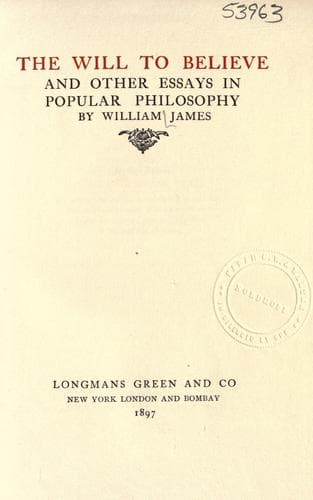
The Will to Believe, and Other Essays in Popular PhilosophyJames, William
Religion
The Will to Believe, and Other Essays in Popular Philosophy
James, William
Belief and doubt; Essays; Philosophy
cohesion between psychical states is proportionate to the frequency
with which the relation between the answering external phenomena has
been repeated in experience."[15]
{247}
But, in spite of all these facts, I have no hesitation whatever in
holding firm to the darwinian distinction even here. I maintain that
the facts in question are all drawn from the lower strata of the mind,
so to speak,--from the sphere of its least evolved functions, from the
region of intelligence which man possesses in common with the brutes.
And I can easily show that throughout the whole extent of those mental
departments which are highest, which are most characteristically human,
Spencer's law is violated at every step; and that as a matter of fact
the new conceptions, emotions, and active tendencies which evolve are
originally produced in the shape of random images, fancies, accidental
out-births of spontaneous variation in the functional activity of the
excessively instable human brain, which the outer environment simply
confirms or refutes, adopts or rejects, preserves or
destroys,--selects, in short, just as it selects morphological and
social variations due to molecular accidents of an analogous sort.
It is one of the tritest of truisms that human intelligences of a
simple order are very literal. They are slaves of habit, doing what
they have been taught without variation; dry, prosaic, and
matter-of-fact in their remarks; devoid of humor, except of the coarse
physical kind which rejoices in a practical joke; taking the world for
granted; and possessing in their faithfulness and honesty the single
gift by which they are sometimes able to warm us into admiration. But
{248} even this faithfulness seems to have a sort of inorganic ring,
and to remind us more of the immutable properties of a piece of
inanimate matter than of the steadfastness of a human will capable of
alternative choice. When we descend to the brutes, all these
peculiarities are intensified. No reader of Schopenhauer can forget
his frequent allusions to the _trockener ernst_ of dogs and horses, nor
to their _ehrlichkeit_. And every noticer of their ways must receive a
deep impression of the fatally literal character of the few, simple,
and treadmill-like operations of their minds.
Public-domain text, read in full here on John Shaqi.
Reviews
Reviews
No reviews yet
Be the first to share your thoughts on this work.
Elsewhere in the archive
Join the Discussion
Join the discussion
Sign in to leave a comment or review.
Sign InorCreate an account