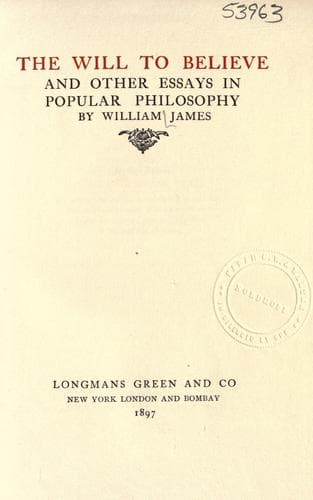
The Will to Believe, and Other Essays in Popular PhilosophyJames, William
Religion
The Will to Believe, and Other Essays in Popular Philosophy
James, William
Belief and doubt; Essays; Philosophy
No concrete test of what is really true has ever been agreed upon.
Some make the criterion external to the moment of perception, putting
it either in revelation, the _consensus gentium_, the instincts of the
heart, or the systematized experience of the race. Others make the
perceptive moment its own test,--Descartes, for instance, with his
clear and distinct ideas guaranteed by the veracity of God; Reid with
his 'common-sense;' and Kant with his forms of synthetic judgment _a
priori_. The inconceivability of the opposite; the capacity to be
verified by sense; the possession of complete organic unity or
self-relation, realized when a thing is its own other,--are standards
which, in turn, have been used. The much {16} lauded objective
evidence is never triumphantly there, it is a mere aspiration or
_Grenzbegriff_, marking the infinitely remote ideal of our thinking
life. To claim that certain truths now possess it, is simply to say
that when you think them true and they _are_ true, then their evidence
is objective, otherwise it is not. But practically one's conviction
that the evidence one goes by is of the real objective brand, is only
one more subjective opinion added to the lot. For what a contradictory
array of opinions have objective evidence and absolute certitude been
claimed! The world is rational through and through,--its existence is
an ultimate brute fact; there is a personal God,--a personal God is
inconceivable; there is an extra-mental physical world immediately
known,--the mind can only know its own ideas; a moral imperative
exists,--obligation is only the resultant of desires; a permanent
spiritual principle is in every one,--there are only shifting states of
mind; there is an endless chain of causes,--there is an absolute first
cause; an eternal necessity,--a freedom; a purpose,--no purpose; a
primal One,--a primal Many; a universal continuity,--an essential
discontinuity in things; an infinity,--no infinity. There is
this,--there is that; there is indeed nothing which some one has not
thought absolutely true, while his neighbor deemed it absolutely false;
and not an absolutist among them seems ever to have considered that the
trouble may all the time be essential, and that the intellect, even
with truth directly in its grasp, may have no infallible signal for
knowing whether it be truth or no. When, indeed, one remembers that
the most striking practical application to life of the doctrine of
objective certitude has been {17} the conscientious labors of the Holy
Office of the Inquisition, one feels less tempted than ever to lend the
doctrine a respectful ear.
Public-domain text, read in full here on John Shaqi.
Reviews
Reviews
No reviews yet
Be the first to share your thoughts on this work.
Join the Discussion
Join the discussion
Sign in to leave a comment or review.
Sign InorCreate an account