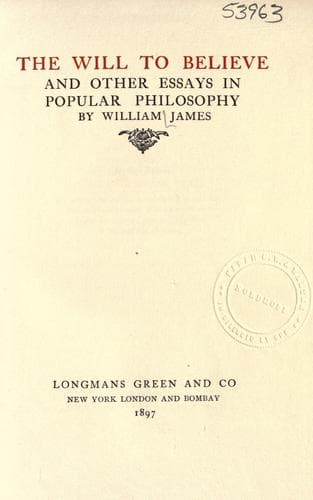
The Will to Believe, and Other Essays in Popular PhilosophyJames, William
Religion
The Will to Believe, and Other Essays in Popular Philosophy
James, William
Belief and doubt; Essays; Philosophy
"Thus the belief in an unchanging order, the belief in _law_, is a
belief of which the primitive man is absolutely incapable....
Experiences such as he receives furnish but few data for the conception
of uniformity, whether as displayed in things or in relations.... The
daily {252} impressions which the savage gets yield the notion very
imperfectly, and in but few cases. Of all the objects around,--trees,
stones, hills, pieces of water, clouds, and so forth,--most differ
widely, ... and few approach complete likeness so nearly as to make
discrimination difficult. Even between animals of the same species it
rarely happens that, whether alive or dead, they are presented in just
the same attitudes.... It is only along with a gradual development of
the arts ... that there come frequent experiences of perfectly straight
lines admitting of complete apposition, bringing the perceptions of
equality and inequality. Still more devoid is savage life of the
experiences which generate the conception of the uniformity of
succession. The sequences observed from hour to hour and day to day
seem anything but uniform, difference is a far more conspicuous trait
among them.... So that if we contemplate primitive human life as a
whole, we see that multiformity of sequence, rather than uniformity, is
the notion which it tends to generate.... Only as fast as the practice
of the arts develops the idea of measure can the consciousness of
uniformity become clear.... Those conditions furnished by advancing
civilization which make possible the notion of uniformity
simultaneously make possible the notion of _exactness_.... Hence the
primitive man has little experience which cultivates the consciousness
of what we call _truth_. How closely allied this is to the
consciousness which the practice of the arts cultivates is implied even
in language. We speak of a true surface as well as a true statement.
Exactness describes perfection in a mechanical fit, as well as perfect
agreement between the results of calculations."
The whole burden of Mr. Spencer's book is to show the fatal way in
which the mind, supposed passive, is moulded by its experiences of
'outer {253} relations.' In this chapter the yard-stick, the balance,
the chronometer, and other machines and instruments come to figure
among the 'relations' external to the mind. Surely they are so, after
they have been manufactured; but only because of the preservative power
of the social environment. Originally all these things and all other
institutions were flashes of genius in an individual head, of which the
outer environment showed no sign. Adopted by the race and become its
heritage, they then supply instigations to new geniuses whom they
environ to make new inventions and discoveries; and so the ball of
progress rolls. But take out the geniuses, or alter their
idiosyncrasies, and what increasing uniformities will the environment
show? We defy Mr. Spencer or any one else to reply.
Public-domain text, read in full here on John Shaqi.
Reviews
Reviews
No reviews yet
Be the first to share your thoughts on this work.
Elsewhere in the archive
Join the Discussion
Join the discussion
Sign in to leave a comment or review.
Sign InorCreate an account