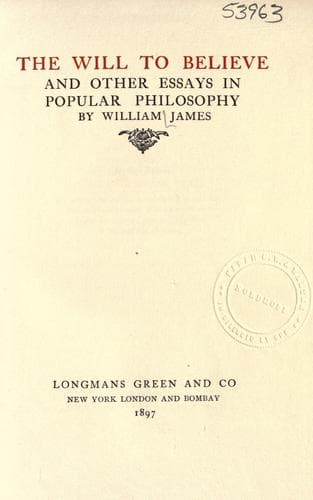
The Will to Believe, and Other Essays in Popular PhilosophyJames, William
Religion
The Will to Believe, and Other Essays in Popular Philosophy
James, William
Belief and doubt; Essays; Philosophy
The plain truth is that the 'philosophy' of evolution (as distinguished
from our special information about particular cases of change) is a
metaphysical creed, and nothing else. It is a mood of contemplation,
an emotional attitude, rather than a system of thought,--a mood which
is old as the world, and which no refutation of any one incarnation of
it (such as the spencerian philosophy) will dispel; the mood of
fatalistic pantheism, with its intuition of the One and All, which was,
and is, and ever shall be, and from whose womb each single thing
proceeds. Far be it from us to speak slightingly here of so hoary and
mighty a style of looking on the world as this. What we at present
call scientific discoveries had nothing to do with bringing it to
birth, nor can one easily conceive that they should ever give it its
_quietus_, no matter how logically incompatible with its spirit the
ultimate phenomenal distinctions which {254} science accumulates should
turn out to be. It can laugh at the phenomenal distinctions on which
science is based, for it draws its vital breath from a region
which--whether above or below--is at least altogether different from
that in which science dwells. A critic, however, who cannot disprove
the truth of the metaphysic creed, can at least raise his voice in
protest against its disguising itself in 'scientific' plumes. I think
that all who have had the patience to follow me thus far will agree
that the spencerian 'philosophy' of social and intellectual progress is
an obsolete anachronism, reverting to a pre-darwinian type of thought,
just as the spencerian philosophy of 'Force,' effacing all the previous
distinctions between actual and potential energy, momentum, work,
force, mass, etc., which physicists have with so much agony achieved,
carries us back to a pre-galilean age.
[1] A lecture before the Harvard Natural History Society; published in
the Atlantic Monthly, October, 1880.
[2] Darwin's theory of pangenesis is, it is true, an attempt to account
(among other things) for variation. But it occupies its own separate
place, and its author no more invokes the environment when he talks of
the adhesions of gemmules than he invokes these adhesions when he talks
of the relations of the whole animal to the environment. _Divide et
impera!_
[3] It is true that it remodels him, also, to some degree, by its
educative influence, and that this constitutes a considerable
difference between the social case and the zoölogical case, I neglect
this aspect of the relation here, for the other is the more important.
At the end of the article I will return to it incidentally.
[4] The reader will remember when this was written.
[5] Lectures and Essays, i. 82.
Public-domain text, read in full here on John Shaqi.
Reviews
Reviews
No reviews yet
Be the first to share your thoughts on this work.
Elsewhere in the archive
Join the Discussion
Join the discussion
Sign in to leave a comment or review.
Sign InorCreate an account