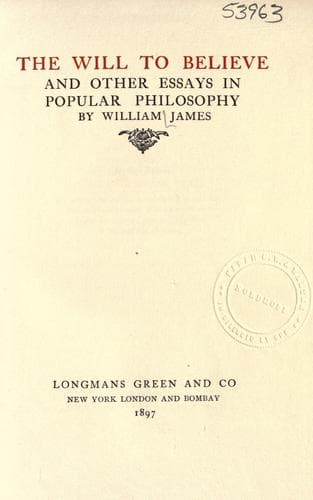
The Will to Believe, and Other Essays in Popular PhilosophyJames, William
Religion
The Will to Believe, and Other Essays in Popular Philosophy
James, William
Belief and doubt; Essays; Philosophy
only to their friends as persons of strong and original character and
judgment. What has started them on their career of effective greatness
is simply the accident of each stumbling upon a task vast, brilliant,
and congenial enough to call out the convergence of all his passions
and powers. I see no more reason why, in case they had not fallen in
with their several hobbies at propitious periods in their life, they
need necessarily have hit upon other hobbies, and made themselves
equally great. Their case seems similar to that of the Washingtons,
Cromwells, and Grants, who simply rose to their occasions. But apart
from these causes of fallacy, I am strongly disposed to think that
where transcendent geniuses are concerned the numbers anyhow are so
small that their appearance will not fit into any scheme of averages.
That is, two or three might appear together, just as the two or three
balls nearest the target centre might be fired consecutively. Take
longer epochs and more firing, and the great geniuses and near balls
would on the whole be more spread out.
[13] Since this paper was written, President Cleveland has to a certain
extent met the need. But who can doubt that if he had certain other
qualities which he has not yet shown, his influence would have been
still more decisive? (1896.)
[14] That is, if a certain general character be rapidly repeated in our
outer experience with a number of strongly contrasted concomitants, it
will be sooner abstracted than if its associates are invariable or
monotonous.
[14] Principles of Psychology, i. 460. See also pp. 463, 464, 500. On
page 408 the law is formulated thus: The _persistence_ of the
connection in consciousness is proportionate to the _persistence_ of
the outer connection. Mr. Spencer works most with the law of
frequency. Either law, from my point of view, is false; but Mr.
Spencer ought not to think them synonymous.
[16] In his Principles of Science, chapters xi., xii., xxvi.
[17] Part viii. chap. iii.
{255}
THE IMPORTANCE OF INDIVIDUALS.
The previous Essay, on Great Men, etc., called forth two replies,--one
by Mr. Grant Allen, entitled the 'Genesis of Genius,' in the Atlantic
Monthly, vol. xlvii. p. 351; the other entitled 'Sociology and Hero
Worship,' by Mr. John Fiske, _ibidem_, p. 75. The article which
follows is a rejoinder to Mr. Allen's article. It was refused at the
time by the Atlantic, but saw the day later in the Open Court for
August, 1890. It appears here as a natural supplement to the foregoing
article, on which it casts some explanatory light.
Public-domain text, read in full here on John Shaqi.
Reviews
Reviews
No reviews yet
Be the first to share your thoughts on this work.
Elsewhere in the archive
Join the Discussion
Join the discussion
Sign in to leave a comment or review.
Sign InorCreate an account